The build123d Examples
Overview
In the GitHub repository you will find an examples folder.
Most of the examples show the builder and algebra modes.
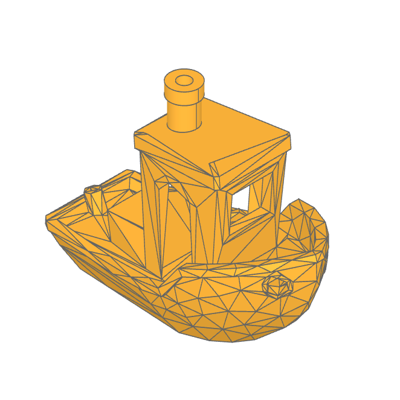
Benchy
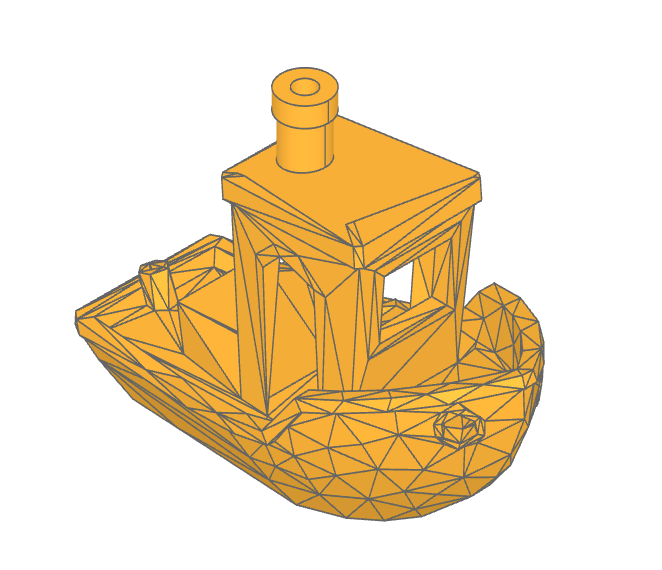
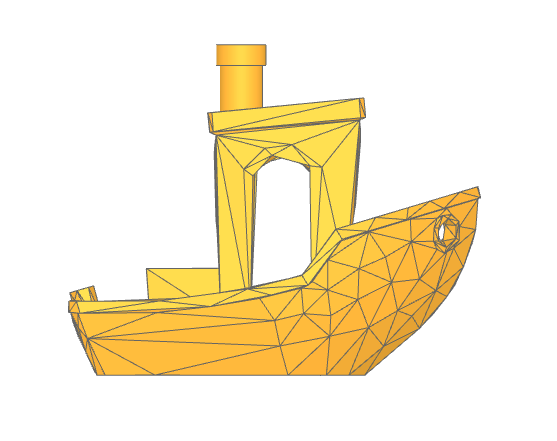
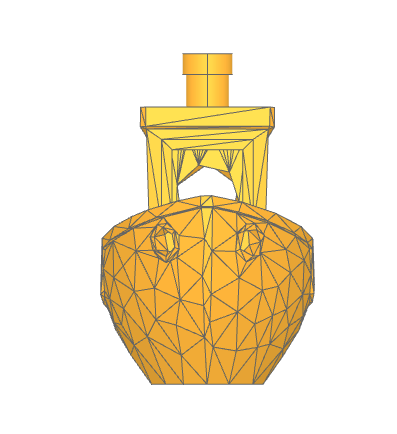
The Benchy examples shows how to import a STL model as a Solid object with the class Mesher and modify it by replacing chimney with a BREP version.
Benchy STL model:
low_poly_benchy.stl
Gallery
🔨 Reference Implementation (Builder Mode)
# Import the benchy as a Solid model
importer = Mesher()
benchy_stl = importer.read("low_poly_benchy.stl")[0]

with BuildPart() as benchy:
    add(benchy_stl)

    # Determine the plane that defines the top of the roof
    vertices = benchy.vertices()
    roof_vertices = vertices.filter_by_position(Axis.Z, 38, 42)
    roof_plane_vertices = [
        roof_vertices.group_by(Axis.Y, tol_digits=2)[-1].sort_by(Axis.X)[0],
        roof_vertices.sort_by(Axis.Z)[0],
        roof_vertices.group_by(Axis.Y, tol_digits=2)[0].sort_by(Axis.X)[0],
    ]
    roof_plane = Plane(
        Face(Wire.make_polygon([v.to_tuple() for v in roof_plane_vertices]))
    )
    # Remove the faceted smoke stack
    split(bisect_by=roof_plane, keep=Keep.BOTTOM)

    # Determine the position and size of the smoke stack
    smoke_stack_vertices = vertices.group_by(Axis.Z, tol_digits=0)[-1]
    smoke_stack_center = sum(
        [Vector(v.X, v.Y, v.Z) for v in smoke_stack_vertices], Vector()
    ) * (1 / len(smoke_stack_vertices))
    smoke_stack_radius = max(
        [
            (Vector(*v.to_tuple()) - smoke_stack_center).length
            for v in smoke_stack_vertices
        ]
    )

    # Create the new smoke stack
    with BuildSketch(Plane(smoke_stack_center)):
        Circle(smoke_stack_radius)
        Circle(smoke_stack_radius - 2 * MM, mode=Mode.SUBTRACT)
    extrude(amount=-3 * MM)
    with BuildSketch(Plane(smoke_stack_center)):
        Circle(smoke_stack_radius - 0.5 * MM)
        Circle(smoke_stack_radius - 2 * MM, mode=Mode.SUBTRACT)
    extrude(amount=roof_plane_vertices[1].Z - smoke_stack_center.Z)

show(benchy)
Bicycle Tire
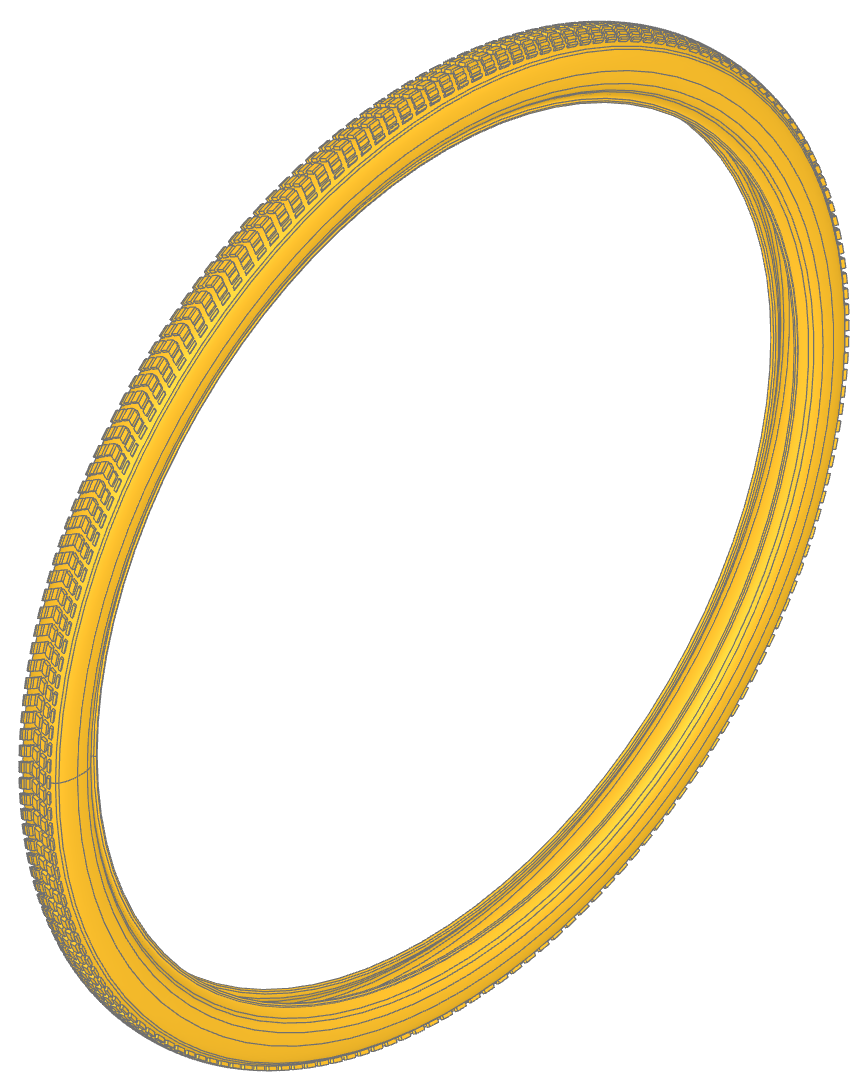
This example demonstrates how to model a realistic bicycle tire with a patterned tread using build123d. The key concept showcased here is the use of wrap_faces to project 2D planar geometry onto a curved 3D surface.
🔨 Reference Implementation (Builder Mode)
import copy
from build123d import *
from ocp_vscode import show

wheel_diameter = 740 * MM

with BuildSketch() as tire_profile:
    with BuildLine() as build_profile:
        l00 = Bezier((0.0, 0.0), (7.05, 0.0), (12.18, 1.54), (15.13, 4.54))
        l01 = Bezier(l00 @ 1, (15.81, 5.22), (15.98, 5.44), (16.5, 6.23))
        l02 = Bezier(l01 @ 1, (18.45, 9.19), (19.61, 13.84), (19.94, 20.06))
        l03 = Bezier(l02 @ 1, (20.1, 23.24), (19.93, 27.48), (19.56, 29.45))
        l04 = Bezier(l03 @ 1, (19.13, 31.69), (18.23, 33.67), (16.91, 35.32))
        l05 = Bezier(l04 @ 1, (16.26, 36.12), (15.57, 36.77), (14.48, 37.58))
        l06 = Bezier(l05 @ 1, (12.77, 38.85), (11.51, 40.28), (10.76, 41.78))
        l07 = Bezier(l06 @ 1, (10.07, 43.16), (10.15, 43.81), (11.03, 43.98))
        l08 = Bezier(l07 @ 1, (11.82, 44.13), (12.15, 44.55), (12.08, 45.33))
        l09 = Bezier(l08 @ 1, (12.01, 46.07), (11.84, 46.43), (11.43, 46.69))
        l10 = Bezier(l09 @ 1, (10.98, 46.97), (10.07, 46.7), (9.47, 46.1))
        l11 = Bezier(l10 @ 1, (9.03, 45.65), (8.88, 45.31), (8.84, 44.65))
        l12 = Bezier(l11 @ 1, (8.78, 43.6), (9.11, 42.26), (9.72, 41.0))
        l13 = Bezier(l12 @ 1, (10.43, 39.54), (11.52, 38.2), (12.78, 37.22))
        l14 = Bezier(l13 @ 1, (15.36, 35.23), (16.58, 33.76), (17.45, 31.62))
        l15 = Bezier(l14 @ 1, (17.91, 30.49), (18.22, 29.27), (18.4, 27.8))
        l16 = Bezier(l15 @ 1, (18.53, 26.78), (18.52, 23.69), (18.37, 22.61))
        l17 = Bezier(l16 @ 1, (17.8, 18.23), (16.15, 14.7), (13.39, 11.94))
        l18 = Bezier(l17 @ 1, (11.89, 10.45), (10.19, 9.31), (8.09, 8.41))
        l19 = Bezier(l18 @ 1, (3.32, 6.35), (0.0, 6.64))
        mirror(about=Plane.YZ)
    make_face()

tire = revolve(Pos(Y=-wheel_diameter / 2) * tire_profile.face(), Axis.X)

with BuildSketch() as tread_pattern:
    with Locations((1, 1)):
        Trapezoid(15, 12, 60, 120, align=Align.MIN)
    with Locations((1, 8)):
        with GridLocations(0, 5, 1, 2):
            Rectangle(50, 2, mode=Mode.SUBTRACT)

# Define the surface and path that the tread pattern will be wrapped onto
half_road_surface = Face.revolve(Pos(Y=-wheel_diameter / 2) * l00, 360, Axis.X)
tread_path = half_road_surface.edges().sort_by(Axis.X)[0]

# Wrap the planar tread pattern onto the tire's outside surface
tread_faces = half_road_surface.wrap_faces(tread_pattern.faces(), tread_path)

# Mirror the faces to the other half of the tire
tread_faces.extend([mirror(t, Plane.YZ) for t in tread_faces])

# Thicken the tread to become solid nubs
# tread_prime = [Solid.thicken(f, 3 * MM) for f in tread_faces]
tread_prime = [thicken(f, 3 * MM) for f in tread_faces]

# Copy the nubs around the whole tire
tread = [Rot(X=r) * copy.copy(t) for t in tread_prime for r in range(0, 360, 2)]

show(tire, tread)
Bracelet
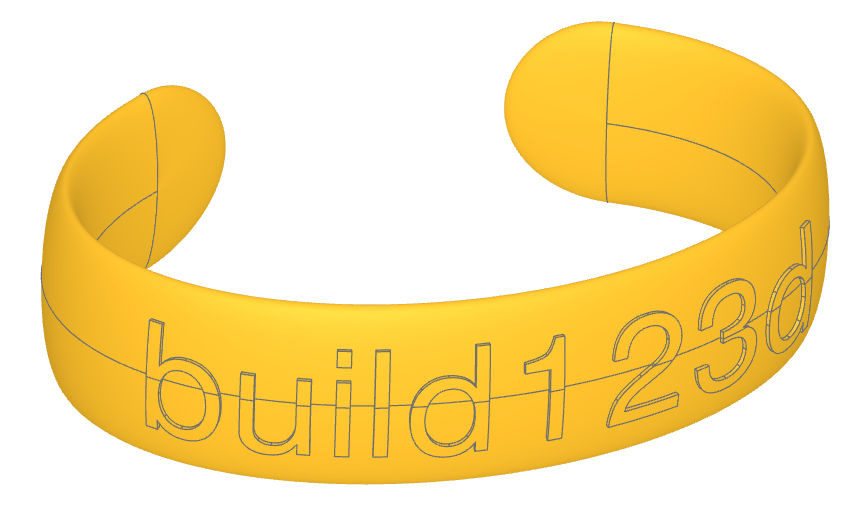
Doubly-curved bracelet with an embossed label
This model is a good “stress test” for OCCT because most of the final boundary surfaces are freeform (not analytic planes/cylinders/spheres). The geometry is assembled from:
a swept center section (using a curved solid end-face as the sweep profile)
two freeform “tip caps” built as Gordon surfaces (network of curves)
an optional embossed text label projected onto a curved solid
alignment holes for splitting/printing/assembly
Key techniques demonstrated:
using location_at/position_at/tangent (%) to extract local frames & tangents
projecting curves onto a non-planar surface to create “true” 3D guide curves
Gordon surfaces to build high-quality doubly-curved skins
projecting faces (text) onto a complex solid and thickening them
✏️ Reference Implementation (Algebra Mode)
from build123d import *
from ocp_vscode import show

# Define input parameters
# - radii: ellipse radii (X, Y) controlling the bracelet centerline shape
# - width: bracelet width (along Z for the center sweep)
# - thickness: bracelet thickness (radial thickness of the cross section)
# - opening_angle: the missing angle that creates the wrist opening
# - label_str: optional text to emboss on the outside surface
# - Define input parameters
# radii, width, thickness, opening_angle, label_str = (45, 30), 25, 5, 80, "build123d"
radii, width, thickness, opening_angle, label_str = (45, 30), 25, 5, 80, ""

# Step 1: Create an elliptical arc defining the *centerline* of the bracelet.
# The arc is truncated to leave an opening (the "gap" where the bracelet goes on).
# Angles are in degrees; 270° points downward, which keeps the opening centered at the bottom.
center_arc = EllipticalCenterArc(
    (0, 0), *radii, 270 + opening_angle / 2, arc_size=360 - opening_angle
)

# Step 2: Create HALF of the end cross-section, positioned at the end of the arc.
# We build only half so we can later mirror it to enforce symmetry and reduce
# curve-network complexity when building the freeform tip.
#
# location_at(1) returns a local coordinate frame at the arc end (tangent-aware).
# x_dir is chosen so the section’s local "X" is well-defined and stable.
end_center_arc = center_arc.location_at(1, x_dir=(0, 0, 1))
half_x_section = EllipticalCenterArc(
    (0, 0), width / 2, thickness / 2, 90, arc_size=180
).locate(end_center_arc)

# Step 3: Create a doubly-curved "tip edge" curve.
# The tip edge must live in 3D and conform to the outside of the bracelet.
# To do that, we:
#   1) create a surface by extruding the center_arc into a sheet (a ribbon surface)
#   2) build a planar arc in a local frame at the end of that surface
#   3) project the planar arc onto the curved surface to get a true 3D curve
#
# The resulting tip_arc is a 3D edge that naturally matches the bracelet curvature.
center_surface = -Face.extrude(center_arc, (0, 0, 2 * width)).moved(
    Location((0, 0, -width), (0, 0, 180))
)
tip_center_loc = -center_surface.location_at(center_arc @ 1, x_dir=(1, 0, 0))
normal_at_tip_center = tip_center_loc.z_axis.direction

# A planar arc that would represent the outer boundary of the tip *if* the surface
# were flat. We immediately project it to make it truly conformal in 3D.
planar_tip_arc = CenterArc((0, 0), width / 2, 270, 180).locate(tip_center_loc).edge()
tip_arc = planar_tip_arc.project_to_shape(center_surface, -normal_at_tip_center)[0]

# Step 4: Build the tip as a Gordon surface (a surface fit through a curve network).
# Gordon surfaces are ideal when:
#   - you don’t have an obvious analytic surface
#   - curvature changes in two directions (doubly-curved "cap")
#   - you can define a consistent set of profile curves + guide curves
#
# Here:
#   - profiles define "across the tip" shape (section -> bulged spline -> mirrored section)
#   - guides define "along the tip" rails (start point -> projected 3D arc -> end point)
#
# Tangents are used to encourage smoothness where the tip joins the swept center section.
profile = Spline(
    half_x_section @ 0,
    tip_arc @ 0.5,
    half_x_section @ 1,
    tangents=(center_arc % 1, -(center_arc % 1)),
)
tip_surface = Face.make_gordon_surface(
    profiles=[half_x_section, profile, half_x_section.mirror(Plane.XY)],
    guides=[half_x_section @ 0, tip_arc, half_x_section @ 1],
)

# Step 5: Close the tip surface into a watertight Solid.
# tip_surface is the outer "skin"; we create a side face from its boundary wire
# and make a shell, then a solid.
tip_side = Face(tip_surface.wire())
tip = Solid(Shell([tip_side, tip_surface]))

# Step 6: Sweep the *flat end face* of the tip around the center arc.
# This is the trick that makes the center section compatible with the freeform tip:
# the sweep profile is the same face that bounds the tip, so the join is naturally aligned.
center_section = sweep(tip_side, center_arc).solid()

# Step 7: Assemble the bracelet from the center and two mirrored tips.
# Mirror across YZ to create the opposite end cap.
bracelet = Solid() + [tip, center_section, tip.mirror(Plane.YZ)]

# Step 8: Add an embossed label.
# This is often the hardest operation for OCCT in this model:
# projecting text onto a doubly-curved surface can create many small faces/edges,
# and thickening them adds even more boolean complexity.
if label_str:
    label = Text(label_str, font_size=width * 0.8, align=Align.CENTER)

    # Project the text onto the bracelet using a path-based placement along center_arc.
    # The parameter offsets the label so it sits centered along arc-length.
    p_labels = bracelet.project_faces(
        label, center_arc, 0.5 - 0.5 * (label.bounding_box().size.X) / center_arc.length
    )
    # Turn the projected faces into solids via thickening (embossing).
    embossed_label = [Solid.thicken(f, 0.5) for f in p_labels.faces()]
    bracelet += embossed_label

# Step 9: Add alignment holes to aid assembly after 3D printing in two halves.
# These are placed at evenly spaced locations along the arc (including both ends).
# A small clearance (+0.15) is included for typical FDM tolerances.
alignment_holes = [
    Pos(p) * Cylinder(1.75 / 2 + 0.15, 8)
    for p in [center_arc.position_at(i / 4) for i in range(5)]
]
bracelet -= alignment_holes

show(bracelet)
Former build123d Logo
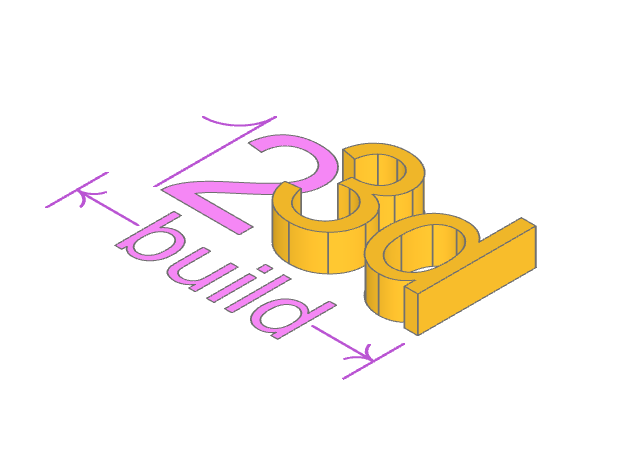
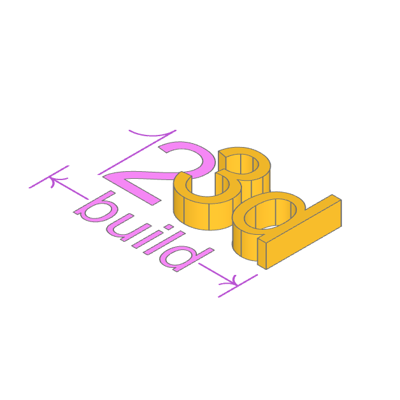
This example creates the former build123d logo (new logo was created in the end of 2023).
Using text and lines to create the first build123d logo. The builder mode example also generates the SVG file logo.svg.
🔨 Reference Implementation (Builder Mode)
with BuildSketch() as logo_text:
    Text("123d", font_size=10, align=(Align.MIN, Align.MIN))
    font_height = logo_text.vertices().sort_by(Axis.Y)[-1].Y

with BuildSketch() as build_text:
    Text("build", font_size=5, align=(Align.CENTER, Align.CENTER))
    build_bb = bounding_box(build_text.sketch, mode=Mode.PRIVATE)
    build_vertices = build_bb.vertices().sort_by(Axis.X)
    build_width = build_vertices[-1].X - build_vertices[0].X

with BuildLine() as one:
    l1 = Line((font_height * 0.3, 0), (font_height * 0.3, font_height))
    TangentArc(l1 @ 1, (0, font_height * 0.7), tangent=(l1 % 1) * -1)

with BuildSketch() as two:
    with Locations((font_height * 0.35, 0)):
        Text("2", font_size=10, align=(Align.MIN, Align.MIN))

with BuildPart() as three_d:
    with BuildSketch(Plane((font_height * 1.1, 0))):
        Text("3d", font_size=10, align=(Align.MIN, Align.MIN))
    extrude(amount=font_height * 0.3)
    logo_width = three_d.vertices().sort_by(Axis.X)[-1].X

with BuildLine() as arrow_left:
    t1 = TangentArc((0, 0), (1, 0.75), tangent=(1, 0))
    mirror(t1, Plane.XZ)

ext_line_length = font_height * 0.5
dim_line_length = (logo_width - build_width - 2 * font_height * 0.05) / 2
with BuildLine() as extension_lines:
    l1 = Line((0, -font_height * 0.1), (0, -ext_line_length - font_height * 0.1))
    l2 = Line(
        (logo_width, -font_height * 0.1),
        (logo_width, -ext_line_length - font_height * 0.1),
    )
    with Locations(l1 @ 0.5):
        add(arrow_left.line)
    with Locations(l2 @ 0.5):
        add(arrow_left.line, rotation=180.0)
    Line(l1 @ 0.5, l1 @ 0.5 + Vector(dim_line_length, 0))
    Line(l2 @ 0.5, l2 @ 0.5 - Vector(dim_line_length, 0))

# Precisely center the build Faces
with BuildSketch() as build:
    with Locations(
        (l1 @ 0.5 + l2 @ 0.5) / 2
        - Vector((build_vertices[-1].X + build_vertices[0].X) / 2, 0)
    ):
        add(build_text.sketch)


if True:
    logo = Compound(
        children=[
            one.line,
            two.sketch,
            three_d.part,
            extension_lines.line,
            build.sketch,
        ]
    )

    # logo.export_step("logo.step")
    def add_svg_shape(svg: ExportSVG, shape: Shape, color: tuple[float, float, float]):
        global counter
        try:
            counter += 1
        except:
            counter = 1

        visible, _hidden = shape.project_to_viewport(
            (-5, 1, 10), viewport_up=(0, 1, 0), look_at=(0, 0, 0)
        )
        if color is not None:
            svg.add_layer(str(counter), fill_color=color, line_weight=1)
        else:
            svg.add_layer(str(counter), line_weight=1)
        svg.add_shape(visible, layer=str(counter))

    svg = ExportSVG(scale=20)
    add_svg_shape(svg, logo, None)
    # add_svg_shape(svg, Compound(children=[one.line, extension_lines.line]), None)
    # add_svg_shape(svg, Compound(children=[two.sketch, build.sketch]), (170, 204, 255))
    # add_svg_shape(svg, three_d.part, (85, 153, 255))
    svg.write("logo.svg")

show_object(one, name="one")
show_object(two, name="two")
show_object(three_d, name="three_d")
show_object(extension_lines, name="extension_lines")
show_object(build, name="build")
✏️ Reference Implementation (Algebra Mode)
logo_text = Text("123d", font_size=10, align=Align.MIN)
font_height = logo_text.vertices().sort_by(Axis.Y).last.Y

build_text = Text("build", font_size=5, align=Align.CENTER)
build_bb = build_text.bounding_box()
build_width = build_bb.max.X - build_bb.min.X

l1 = Line((font_height * 0.3, 0), (font_height * 0.3, font_height))
one = l1 + TangentArc(l1 @ 1, (0, font_height * 0.7), tangent=(l1 % 1) * -1)

two = Pos(font_height * 0.35, 0) * Text("2", font_size=10, align=Align.MIN)

three_d = Text("3d", font_size=10, align=Align.MIN)
three_d = Pos(font_height * 1.1, 0) * extrude(three_d, amount=font_height * 0.3)
logo_width = three_d.vertices().sort_by(Axis.X).last.X

t1 = TangentArc((0, 0), (1, 0.75), tangent=(1, 0))
arrow_left = t1 + mirror(t1, Plane.XZ)

ext_line_length = font_height * 0.5
dim_line_length = (logo_width - build_width - 2 * font_height * 0.05) / 2

l1 = Line((0, -font_height * 0.1), (0, -ext_line_length - font_height * 0.1))
l2 = Line(
    (logo_width, -font_height * 0.1),
    (logo_width, -ext_line_length - font_height * 0.1),
)
extension_lines = Curve() + (l1 + l2)
extension_lines += Pos(*(l1 @ 0.5)) * arrow_left
extension_lines += (Pos(*(l2 @ 0.5)) * Rot(Z=180)) * arrow_left
extension_lines += Line(l1 @ 0.5, l1 @ 0.5 + Vector(dim_line_length, 0))
extension_lines += Line(l2 @ 0.5, l2 @ 0.5 - Vector(dim_line_length, 0))

# Precisely center the build Faces
p1 = Pos((l1 @ 0.5 + l2 @ 0.5) / 2 - Vector((build_bb.max.X + build_bb.min.X) / 2, 0))
build = p1 * build_text

cmpd = Compound([three_d, two, one, build, extension_lines])

show_object(cmpd, name="compound")
Cast Bearing Unit
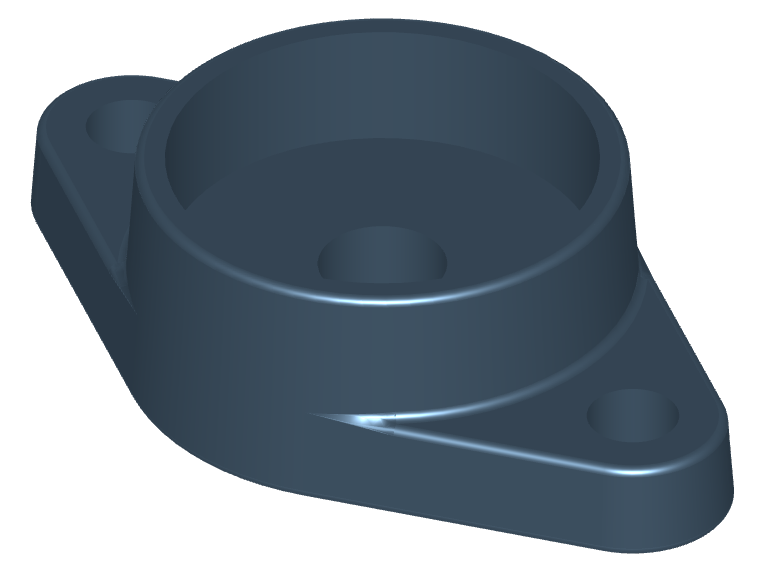
This example demonstrates the creation of a castable flanged bearing housing using the draft operation to add appropriate draft angles for mold release.
🔨 Reference Implementation (Builder Mode)
from build123d import *
from ocp_vscode import show

A, A1, Db2, H, J = 26, 11, 57, 98.5, 76.5
with BuildPart() as oval_flanged_bearing_unit:
    with BuildSketch() as plan:
        housing = Circle(Db2 / 2)
        with GridLocations(J, 0, 2, 1) as bolt_centers:
            Circle((H - J) / 2)
        make_hull()
    extrude(amount=A1)
    extrude(housing, amount=A)
    drafted_faces = oval_flanged_bearing_unit.faces().filter_by(Axis.Z, reverse=True)
    draft(drafted_faces, Plane.XY, 4)
    fillet(oval_flanged_bearing_unit.edges(), 1)
    with Locations(oval_flanged_bearing_unit.faces().sort_by(Axis.Z)[-1]):
        CounterBoreHole(14 / 2, 47 / 2, 14)
    with Locations(*bolt_centers):
        Hole(5)

oval_flanged_bearing_unit.part.color = Color(0x4C6377)

show(oval_flanged_bearing_unit)
Canadian Flag Blowing in The Wind
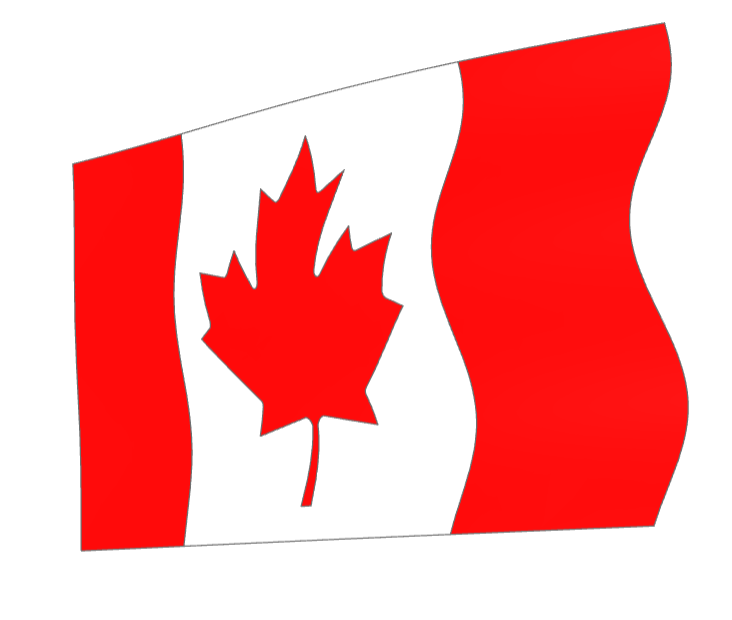
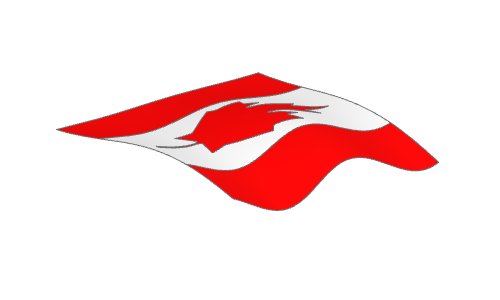
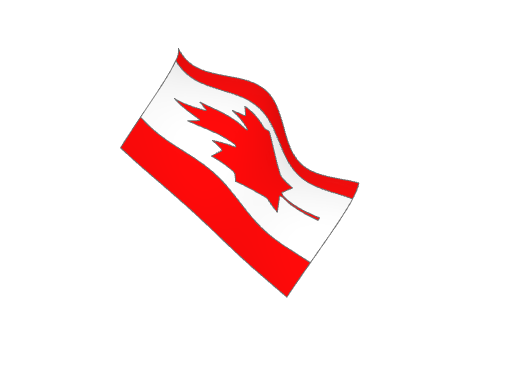
A Canadian Flag blowing in the wind created by projecting planar faces onto a non-planar face (the_wind).
This example also demonstrates building complex lines that snap to existing features.
More Images
🔨 Reference Implementation (Builder Mode)
def surface(amplitude, u, v):
    """Calculate the surface displacement of the flag at a given position"""
    return v * amplitude / 20 * cos(3.5 * pi * u) + amplitude / 10 * v * sin(
        1.1 * pi * v
    )


# Note that the surface to project on must be a little larger than the faces
# being projected onto it to create valid projected faces
the_wind = Face.make_surface_from_array_of_points(
    [
        [
            Vector(
                width * (v * 1.1 / 40 - 0.05),
                height * (u * 1.2 / 40 - 0.1),
                height * surface(wave_amplitude, u / 40, v / 40) / 2,
            )
            for u in range(41)
        ]
        for v in range(41)
    ]
)
with BuildSketch(Plane.XY.offset(10)) as west_field_builder:
    Rectangle(width / 4, height, align=(Align.MIN, Align.MIN))
west_field_planar = west_field_builder.sketch.faces()[0]
east_field_planar = west_field_planar.mirror(Plane.YZ.offset(width / 2))

with BuildSketch(Plane((width / 2, 0, 10))) as center_field_builder:
    Rectangle(width / 2, height, align=(Align.CENTER, Align.MIN))
    with BuildSketch(
        Plane((width / 2, 0, 10)), mode=Mode.SUBTRACT
    ) as maple_leaf_builder:
        with BuildLine() as outline:
            l1 = Polyline((0.0000, 0.0771), (0.0187, 0.0771), (0.0094, 0.2569))
            l2 = Polyline((0.0325, 0.2773), (0.2115, 0.2458), (0.1873, 0.3125))
            RadiusArc(l1 @ 1, l2 @ 0, 0.0271)
            l3 = Polyline((0.1915, 0.3277), (0.3875, 0.4865), (0.3433, 0.5071))
            TangentArc(l2 @ 1, l3 @ 0, tangent=l2 % 1)
            l4 = Polyline((0.3362, 0.5235), (0.375, 0.6427), (0.2621, 0.6188))
            SagittaArc(l3 @ 1, l4 @ 0, 0.003)
            l5 = Polyline((0.2469, 0.6267), (0.225, 0.6781), (0.1369, 0.5835))
            ThreePointArc(
                l4 @ 1, (l4 @ 1 + l5 @ 0) * 0.5 + Vector(-0.002, -0.002), l5 @ 0
            )
            l6 = Polyline((0.1138, 0.5954), (0.1562, 0.8146), (0.0881, 0.7752))
            Spline(
                l5 @ 1,
                l6 @ 0,
                tangents=(l5 % 1, l6 % 0),
                tangent_scalars=(2, 2),
            )
            l7 = Line((0.0692, 0.7808), (0.0000, 0.9167))
            TangentArc(l6 @ 1, l7 @ 0, tangent=l6 % 1)
            mirror(outline.edges(), Plane.YZ)
        make_face()
        scale(by=height)
maple_leaf_planar = maple_leaf_builder.sketch.faces()[0]
center_field_planar = center_field_builder.sketch.faces()[0]

west_field = west_field_planar.project_to_shape(the_wind, (0, 0, -1))[0]
west_field.color = Color("red")
east_field = east_field_planar.project_to_shape(the_wind, (0, 0, -1))[0]
east_field.color = Color("red")
center_field = center_field_planar.project_to_shape(the_wind, (0, 0, -1))[0]
center_field.color = Color("white")
maple_leaf = maple_leaf_planar.project_to_shape(the_wind, (0, 0, -1))[0]
maple_leaf.color = Color("red")

canadian_flag = Compound(children=[west_field, east_field, center_field, maple_leaf])
show(Rot(90, 0, 0) * canadian_flag)
✏️ Reference Implementation (Algebra Mode)
def surface(amplitude, u, v):
    """Calculate the surface displacement of the flag at a given position"""
    return v * amplitude / 20 * cos(3.5 * pi * u) + amplitude / 10 * v * sin(
        1.1 * pi * v
    )


# Note that the surface to project on must be a little larger than the faces
# being projected onto it to create valid projected faces
the_wind = Face.make_surface_from_array_of_points(
    [
        [
            Vector(
                width * (v * 1.1 / 40 - 0.05),
                height * (u * 1.2 / 40 - 0.1),
                height * surface(wave_amplitude, u / 40, v / 40) / 2,
            )
            for u in range(41)
        ]
        for v in range(41)
    ]
)

field_planar = Plane.XY.offset(10) * Rectangle(width / 4, height, align=Align.MIN)
west_field_planar = field_planar.faces()[0]
east_field_planar = mirror(west_field_planar, Plane.YZ.offset(width / 2))

l1 = Polyline((0.0000, 0.0771), (0.0187, 0.0771), (0.0094, 0.2569))
l2 = Polyline((0.0325, 0.2773), (0.2115, 0.2458), (0.1873, 0.3125))
r1 = RadiusArc(l1 @ 1, l2 @ 0, 0.0271)
l3 = Polyline((0.1915, 0.3277), (0.3875, 0.4865), (0.3433, 0.5071))
r2 = TangentArc(l2 @ 1, l3 @ 0, tangent=l2 % 1)
l4 = Polyline((0.3362, 0.5235), (0.375, 0.6427), (0.2621, 0.6188))
r3 = SagittaArc(l3 @ 1, l4 @ 0, 0.003)
l5 = Polyline((0.2469, 0.6267), (0.225, 0.6781), (0.1369, 0.5835))
r4 = ThreePointArc(l4 @ 1, (l4 @ 1 + l5 @ 0) * 0.5 + Vector(-0.002, -0.002), l5 @ 0)
l6 = Polyline((0.1138, 0.5954), (0.1562, 0.8146), (0.0881, 0.7752))
s = Spline(
    l5 @ 1,
    l6 @ 0,
    tangents=(l5 % 1, l6 % 0),
    tangent_scalars=(2, 2),
)
l7 = Line((0.0692, 0.7808), (0.0000, 0.9167))
r5 = TangentArc(l6 @ 1, l7 @ 0, tangent=l6 % 1)

outline = l1 + [l2, r1, l3, r2, l4, r3, l5, r4, l6, s, l7, r5]
outline += mirror(outline, Plane.YZ)

maple_leaf_planar = make_face(outline)

center_field_planar = (
    Rectangle(1, 1, align=(Align.CENTER, Align.MIN)) - maple_leaf_planar
)


def scale_move(obj):
    return Plane((width / 2, 0, 10)) * scale(obj, height)


def project(obj):
    return obj.faces()[0].project_to_shape(the_wind, (0, 0, -1))[0]


maple_leaf_planar = scale_move(maple_leaf_planar)
center_field_planar = scale_move(center_field_planar)

west_field = project(west_field_planar)
west_field.color = Color("red")
east_field = project(east_field_planar)
east_field.color = Color("red")
center_field = project(center_field_planar)
center_field.color = Color("white")
maple_leaf = project(maple_leaf_planar)
maple_leaf.color = Color("red")

canadian_flag = Compound(children=[west_field, east_field, center_field, maple_leaf])
show(Rot(90, 0, 0) * canadian_flag)
Circuit Board With Holes
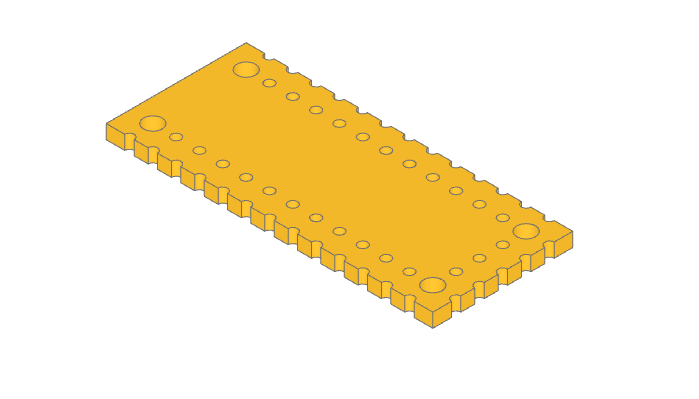
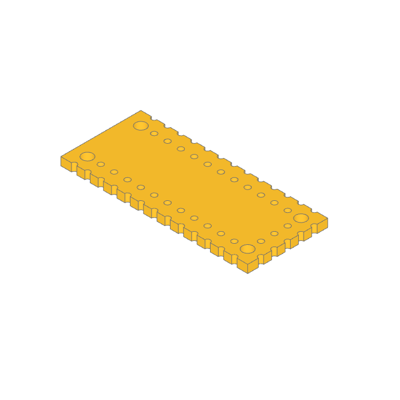
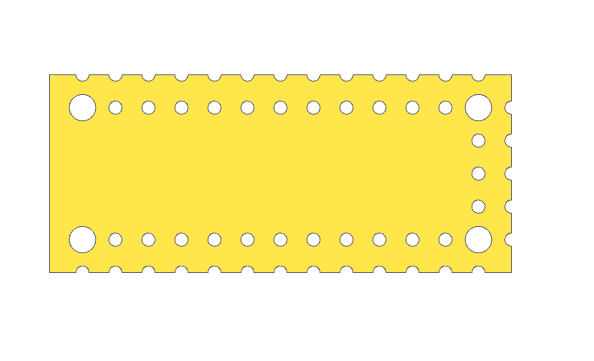
This example demonstrates placing holes around a part.
Builder mode uses Locations context to place the positions.
Algebra mode uses product and range to calculate the positions.
More Images
🔨 Reference Implementation (Builder Mode)
with BuildPart() as pcb:
    with BuildSketch():
        Rectangle(pcb_length, pcb_width)

        for i in range(65 // 5):
            x = i * 5 - 30
            with Locations((x, -15), (x, -10), (x, 10), (x, 15)):
                Circle(1, mode=Mode.SUBTRACT)
        for i in range(30 // 5 - 1):
            y = i * 5 - 10
            with Locations((30, y), (35, y)):
                Circle(1, mode=Mode.SUBTRACT)
        with GridLocations(60, 20, 2, 2):
            Circle(2, mode=Mode.SUBTRACT)
    extrude(amount=pcb_height)

show_object(pcb.part.wrapped)
✏️ Reference Implementation (Algebra Mode)
x_coords = product(range(65 // 5), (-15, -10, 10, 15))
y_coords = product((30, 35), range(30 // 5 - 1))

pcb = Rectangle(pcb_length, pcb_width)
pcb -= [Pos(i * 5 - 30, y) * Circle(1) for i, y in x_coords]
pcb -= [Pos(x, i * 5 - 10) * Circle(1) for x, i in y_coords]
pcb -= [loc * Circle(2) for loc in GridLocations(60, 20, 2, 2)]

pcb = extrude(pcb, pcb_height)

show(pcb)
Clock Face
🔨 Reference Implementation (Builder Mode)
from build123d import *
from ocp_vscode import show

clock_radius = 10
with BuildSketch() as minute_indicator:
    with BuildLine() as outline:
        l1 = CenterArc((0, 0), clock_radius * 0.975, 0.75, 4.5)
        l2 = CenterArc((0, 0), clock_radius * 0.925, 0.75, 4.5)
        Line(l1 @ 0, l2 @ 0)
        Line(l1 @ 1, l2 @ 1)
    make_face()
    fillet(minute_indicator.vertices(), radius=clock_radius * 0.01)

with BuildSketch() as clock_face:
    Circle(clock_radius)
    with PolarLocations(0, 60):
        add(minute_indicator.sketch, mode=Mode.SUBTRACT)
    with PolarLocations(clock_radius * 0.875, 12):
        SlotOverall(clock_radius * 0.05, clock_radius * 0.025, mode=Mode.SUBTRACT)
    for hour in range(1, 13):
        with PolarLocations(clock_radius * 0.75, 1, -hour * 30 + 90, 360, rotate=False):
            Text(
                str(hour),
                font_size=clock_radius * 0.175,
                font_style=FontStyle.BOLD,
                mode=Mode.SUBTRACT,
            )

show(clock_face)
✏️ Reference Implementation (Algebra Mode)
from build123d import *
from ocp_vscode import show

clock_radius = 10

l1 = CenterArc((0, 0), clock_radius * 0.975, 0.75, 4.5)
l2 = CenterArc((0, 0), clock_radius * 0.925, 0.75, 4.5)
l3 = Line(l1 @ 0, l2 @ 0)
l4 = Line(l1 @ 1, l2 @ 1)
minute_indicator = make_face([l1, l3, l2, l4])
minute_indicator = fillet(minute_indicator.vertices(), radius=clock_radius * 0.01)

clock_face = Circle(clock_radius)
clock_face -= PolarLocations(0, 60) * minute_indicator
clock_face -= PolarLocations(clock_radius * 0.875, 12) * SlotOverall(
    clock_radius * 0.05, clock_radius * 0.025
)

clock_face -= [
    loc
    * Text(
        str(hour + 1),
        font_size=clock_radius * 0.175,
        font_style=FontStyle.BOLD,
        align=Align.CENTER,
    )
    for hour, loc in enumerate(
        PolarLocations(clock_radius * 0.75, 12, 60, -360, rotate=False)
    )
]

show(clock_face)
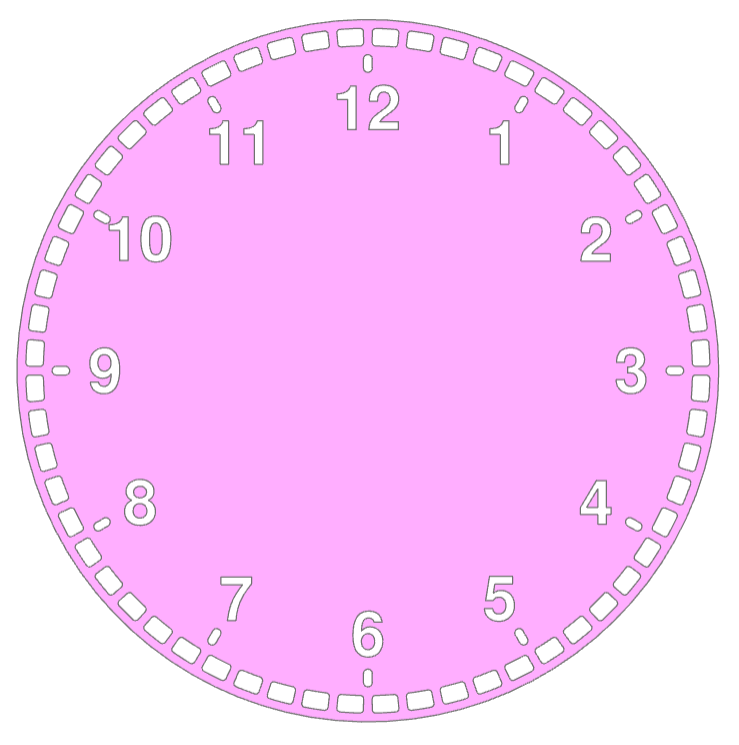
The Python code utilizes the build123d library to create a 3D model of a clock face. It defines a minute indicator with arcs and lines, applying fillets, and then integrates it into the clock face sketch. The clock face includes a circular outline, hour labels, and slots at specified positions. The resulting 3D model represents a detailed and visually appealing clock design.
PolarLocations are used to position features on the clock face.
Fast Grid Holes
✏️ Reference Implementation (Algebra Mode)
import timeit
from build123d import *
from ocp_vscode import show

start_time = timeit.default_timer()

# Calculate the locations of 625 holes
major_r = 10
hole_locs = HexLocations(major_r, 25, 25)

# Create wires for both the perimeter and all the holes
face_perimeter = Rectangle(500, 600).wire()
hex_hole = RegularPolygon(major_r - 1, 6, major_radius=True).wire()
holes = hole_locs * hex_hole

# Create a new Face from the perimeter and hole wires
grid_pattern = Face(face_perimeter, holes)

# Extrude to a 3D part
grid = extrude(grid_pattern, 1)

print(f"Time: {timeit.default_timer() - start_time:0.3f}s")
show(grid)
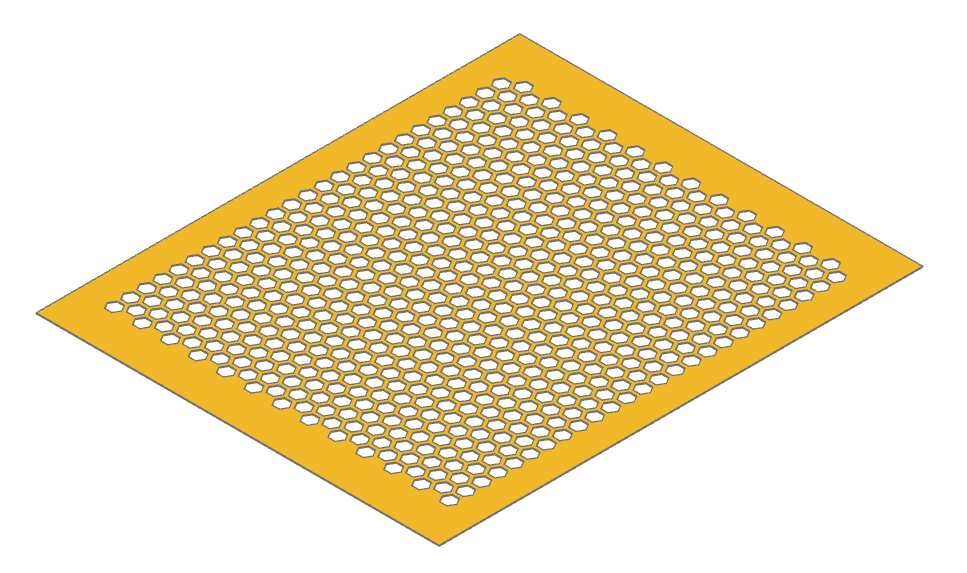
This example demonstrates an efficient approach to creating a large number of holes (625 in this case) in a planar part using build123d.
Instead of modeling and subtracting 3D solids for each hole—which is computationally expensive—this method constructs a 2D Face from an outer perimeter wire and a list of hole wires. The entire face is then extruded in a single operation to form the final 3D object. This approach significantly reduces modeling time and complexity.
The hexagonal hole pattern is generated using HexLocations, and each location is populated with a hexagonal wire. These wires are passed directly to the Face constructor as holes. On a typical Linux laptop, this script completes in approximately 1.02 seconds, compared to substantially longer runtimes for boolean subtraction of individual holes in 3D.
Handle
🔨 Reference Implementation (Builder Mode)
from build123d import *
from ocp_vscode import show_object

segment_count = 6

with BuildPart() as handle:
    # Create a path for the sweep along the handle - added to pending_edges
    with BuildLine() as handle_center_line:
        Spline(
            (-10, 0, 0),
            (0, 0, 5),
            (10, 0, 0),
            tangents=((0, 0, 1), (0, 0, -1)),
            tangent_scalars=(1.5, 1.5),
        )

    # Create the cross sections - added to pending_faces
    for i in range(segment_count + 1):
        with BuildSketch(handle_center_line.line ^ (i / segment_count)) as section:
            if i % segment_count == 0:
                Circle(1)
            else:
                Rectangle(1.25, 3)
                fillet(section.vertices(), radius=0.2)
    # Record the sections for display
    sections = handle.pending_faces

    # Create the handle by sweeping along the path
    sweep(multisection=True)

assert abs(handle.part.volume - 94.77361455046953) < 1e-3

show_object(handle_center_line.line, name="handle_center_line")
for i, section in enumerate(sections):
    show_object(section, name="section" + str(i))
show_object(handle.part, name="handle", options=dict(alpha=0.6))
✏️ Reference Implementation (Algebra Mode)
from build123d import *
from ocp_vscode import show_object

segment_count = 6

# Create a path for the sweep along the handle - added to pending_edges
handle_center_line = Spline(
    (-10, 0, 0),
    (0, 0, 5),
    (10, 0, 0),
    tangents=((0, 0, 1), (0, 0, -1)),
    tangent_scalars=(1.5, 1.5),
)

# Create the cross sections - added to pending_faces
sections = Sketch()
for i in range(segment_count + 1):
    location = handle_center_line ^ (i / segment_count)
    if i % segment_count == 0:
        circle = location * Circle(1)
    else:
        circle = location * Rectangle(1.25, 3)
        circle = fillet(circle.vertices(), radius=0.2)
    sections += circle

# Create the handle by sweeping along the path
handle = sweep(sections, path=handle_center_line, multisection=True)

show_object(handle_center_line, name="handle_path")
for i, circle in enumerate(sections):
    show_object(circle, name="section" + str(i))
show_object(handle, name="handle", options=dict(alpha=0.6))
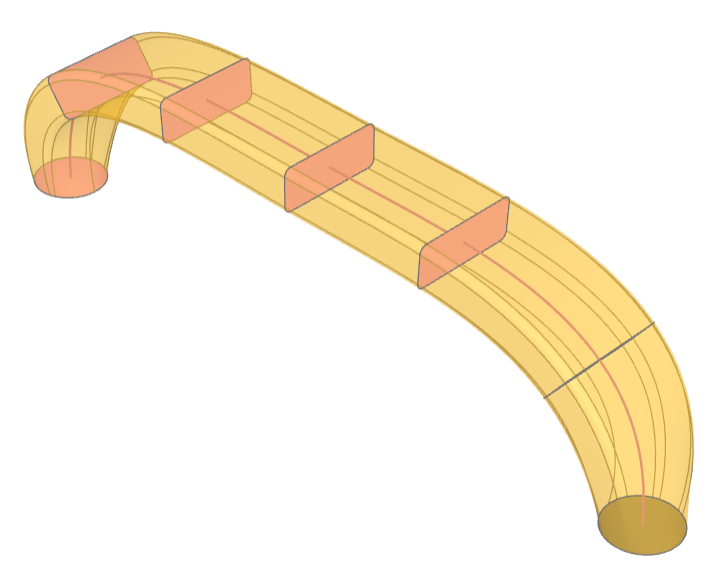
This example demonstrates multisection sweep creating a drawer handle.
Heat Exchanger
🔨 Reference Implementation (Builder Mode)
from build123d import *
from ocp_vscode import show

exchanger_diameter = 10 * CM
exchanger_length = 30 * CM
plate_thickness = 5 * MM
# 149 tubes
tube_diameter = 5 * MM
tube_spacing = 2 * MM
tube_wall_thickness = 0.5 * MM
tube_extension = 3 * MM
bundle_diameter = exchanger_diameter - 2 * tube_diameter
fillet_radius = tube_spacing / 3
assert tube_extension > fillet_radius

# Build the heat exchanger
with BuildPart() as heat_exchanger:
    # Generate list of tube locations
    tube_locations = [
        l
        for l in HexLocations(
            radius=(tube_diameter + tube_spacing) / 2,
            x_count=exchanger_diameter // tube_diameter,
            y_count=exchanger_diameter // tube_diameter,
        )
        if l.position.length < bundle_diameter / 2
    ]
    tube_count = len(tube_locations)
    with BuildSketch() as tube_plan:
        with Locations(*tube_locations):
            Circle(radius=tube_diameter / 2)
            Circle(radius=tube_diameter / 2 - tube_wall_thickness, mode=Mode.SUBTRACT)
    extrude(amount=exchanger_length / 2)
    with BuildSketch(
        Plane(
            origin=(0, 0, exchanger_length / 2 - tube_extension - plate_thickness),
            z_dir=(0, 0, 1),
        )
    ) as plate_plan:
        Circle(radius=exchanger_diameter / 2)
        with Locations(*tube_locations):
            Circle(radius=tube_diameter / 2 - tube_wall_thickness, mode=Mode.SUBTRACT)
    extrude(amount=plate_thickness)
    half_volume_before_fillet = heat_exchanger.part.volume
    # Simulate welded tubes by adding a fillet to the outside radius of the tubes
    fillet(
        heat_exchanger.edges()
        .filter_by(GeomType.CIRCLE)
        .sort_by(SortBy.RADIUS)
        .sort_by(Axis.Z, reverse=True)[2 * tube_count : 3 * tube_count],
        radius=fillet_radius,
    )
    half_volume_after_fillet = heat_exchanger.part.volume
    mirror(about=Plane.XY)

fillet_volume = 2 * (half_volume_after_fillet - half_volume_before_fillet)
assert abs(fillet_volume - 469.88331045553787) < 1e-3

show(heat_exchanger)
✏️ Reference Implementation (Algebra Mode)
from build123d import *
from ocp_vscode import show

exchanger_diameter = 10 * CM
exchanger_length = 30 * CM
plate_thickness = 5 * MM
# 149 tubes
tube_diameter = 5 * MM
tube_spacing = 2 * MM
tube_wall_thickness = 0.5 * MM
tube_extension = 3 * MM
bundle_diameter = exchanger_diameter - 2 * tube_diameter
fillet_radius = tube_spacing / 3
assert tube_extension > fillet_radius

# Build the heat exchanger
tube_locations = [
    l
    for l in HexLocations(
        radius=(tube_diameter + tube_spacing) / 2,
        x_count=exchanger_diameter // tube_diameter,
        y_count=exchanger_diameter // tube_diameter,
    )
    if l.position.length < bundle_diameter / 2
]

ring = Circle(tube_diameter / 2) - Circle(tube_diameter / 2 - tube_wall_thickness)
tube_plan = Sketch() + tube_locations * ring

heat_exchanger = extrude(tube_plan, exchanger_length / 2)

plate_plane = Plane(
    origin=(0, 0, exchanger_length / 2 - tube_extension - plate_thickness),
    z_dir=(0, 0, 1),
)
plate = Circle(radius=exchanger_diameter / 2) - tube_locations * Circle(
    radius=tube_diameter / 2 - tube_wall_thickness
)

heat_exchanger += extrude(plate_plane * plate, plate_thickness)
edges = (
    heat_exchanger.edges()
    .filter_by(GeomType.CIRCLE)
    .group_by(SortBy.RADIUS)[1]
    .group_by()[2]
)
half_volume_before_fillet = heat_exchanger.volume
heat_exchanger = fillet(edges, radius=fillet_radius)
half_volume_after_fillet = heat_exchanger.volume
heat_exchanger += mirror(heat_exchanger, Plane.XY)

fillet_volume = 2 * (half_volume_after_fillet - half_volume_before_fillet)
assert abs(fillet_volume - 469.88331045553787) < 1e-3

show(heat_exchanger)
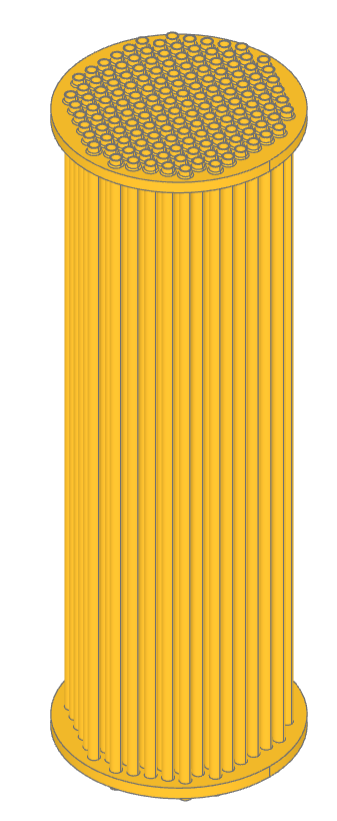
This example creates a model of a parametric heat exchanger core. The positions
of the tubes are defined with HexLocations and further
limited to fit within the circular end caps. The ends of the tubes are filleted
to the end plates to simulate welding.
Key Cap
🔨 Reference Implementation (Builder Mode)
from build123d import *
from ocp_vscode import *

with BuildPart() as key_cap:
    # Start with the plan of the key cap and extrude it
    with BuildSketch() as plan:
        Rectangle(18 * MM, 18 * MM)
    extrude(amount=10 * MM, taper=15)
    # Create a dished top
    with Locations((0, -3 * MM, 47 * MM)):
        Sphere(40 * MM, mode=Mode.SUBTRACT, rotation=(90, 0, 0))
    # Fillet all the edges except the bottom
    fillet(
        key_cap.edges().filter_by_position(Axis.Z, 0, 30 * MM, inclusive=(False, True)),
        radius=1 * MM,
    )
    # Hollow out the key by subtracting a scaled version
    scale(by=(0.925, 0.925, 0.85), mode=Mode.SUBTRACT)

    # Add supporting ribs while leaving room for switch activation
    with BuildSketch(Plane(origin=(0, 0, 4 * MM))):
        Rectangle(15 * MM, 0.5 * MM)
        Rectangle(0.5 * MM, 15 * MM)
        Circle(radius=5.5 * MM / 2)
    # Extrude the mount and ribs to the key cap underside
    extrude(until=Until.NEXT)
    # Find the face on the bottom of the ribs to build onto
    rib_bottom = key_cap.faces().filter_by_position(Axis.Z, 4 * MM, 4 * MM)[0]
    # Add the switch socket
    with BuildSketch(rib_bottom) as cruciform:
        Circle(radius=5.5 * MM / 2)
        Rectangle(4.1 * MM, 1.17 * MM, mode=Mode.SUBTRACT)
        Rectangle(1.17 * MM, 4.1 * MM, mode=Mode.SUBTRACT)
    extrude(amount=3.5 * MM, mode=Mode.ADD)

assert abs(key_cap.part.volume - 644.8900473617498) < 1e-3

show(key_cap, alphas=[0.3])
✏️ Reference Implementation (Algebra Mode)
from build123d import *
from ocp_vscode import *

# Taper Extrude and Extrude to "next" while creating a Cherry MX key cap
# See: https://www.cherrymx.de/en/dev.html

plan = Rectangle(18 * MM, 18 * MM)
key_cap = extrude(plan, amount=10 * MM, taper=15)

# Create a dished top
key_cap -= Location((0, -3 * MM, 47 * MM), (90, 0, 0)) * Sphere(40 * MM)

# Fillet all the edges except the bottom
key_cap = fillet(
    key_cap.edges().filter_by_position(Axis.Z, 0, 30 * MM, inclusive=(False, True)),
    radius=1 * MM,
)

# Hollow out the key by subtracting a scaled version
key_cap -= scale(key_cap, (0.925, 0.925, 0.85))


# Add supporting ribs while leaving room for switch activation
ribs = Rectangle(17.5 * MM, 0.5 * MM)
ribs += Rectangle(0.5 * MM, 17.5 * MM)
ribs += Circle(radius=5.51 * MM / 2)

# Extrude the mount and ribs to the key cap underside
key_cap += extrude(Pos(0, 0, 4 * MM) * ribs, until=Until.NEXT, target=key_cap)


# Find the face on the bottom of the ribs to build onto
rib_bottom = key_cap.faces().filter_by_position(Axis.Z, 4 * MM, 4 * MM)[0]

# Add the switch socket
socket = Circle(radius=5.5 * MM / 2)
socket -= Rectangle(4.1 * MM, 1.17 * MM)
socket -= Rectangle(1.17 * MM, 4.1 * MM)
key_cap += extrude(Plane(rib_bottom) * socket, amount=3.5 * MM)

show(key_cap, alphas=[0.3])
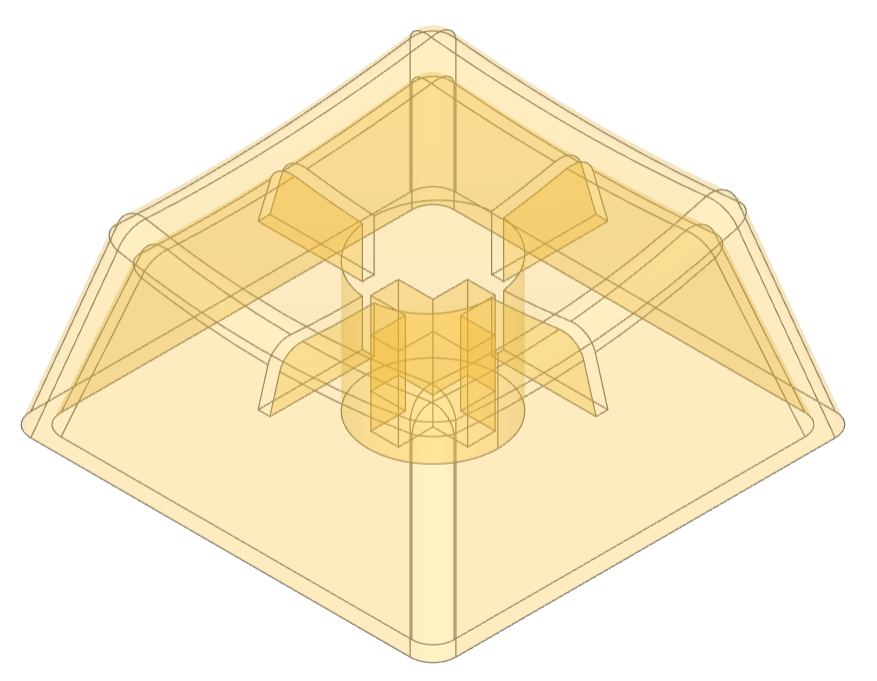
This example demonstrates the design of a Cherry MX key cap by using extrude with a taper and extrude until next.
Maker Coin
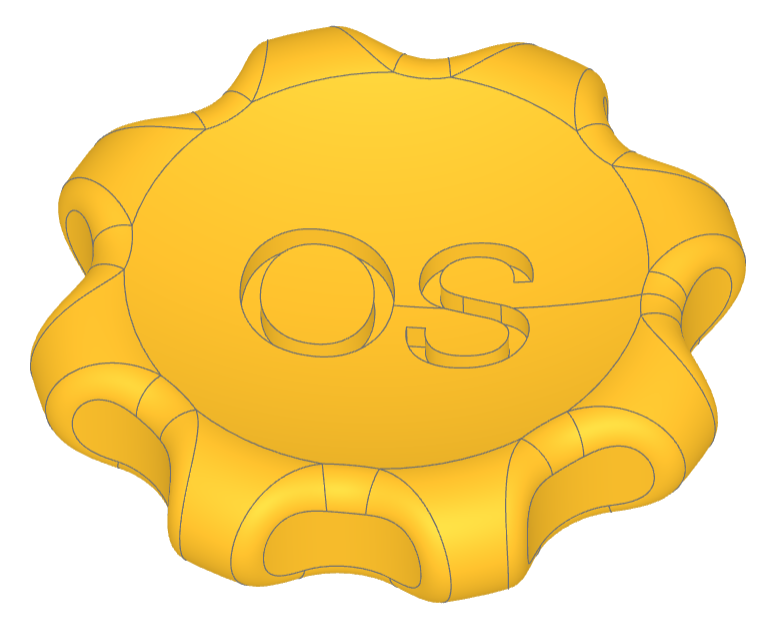
This example creates the maker coin as defined by Angus on the Maker's Muse YouTube channel. There are two key features:
the use of
DoubleTangentArcto create a smooth transition from the central dish to the outside arc, andembossing the text into the top of the coin not just as a simple extrude but from a projection which results in text with even depth.
🔨 Reference Implementation (Builder Mode)
# Coin Parameters
diameter, thickness = 50 * MM, 10 * MM

with BuildPart() as maker_coin:
    # On XZ plane draw the profile of half the coin
    with BuildSketch(Plane.XZ) as profile:
        with BuildLine() as outline:
            l1 = Polyline((0, thickness * 0.6), (0, 0), ((diameter - thickness) / 2, 0))
            l2 = JernArc(
                start=l1 @ 1, tangent=l1 % 1, radius=thickness / 2, arc_size=300
            )  # extend the arc beyond the intersection but not closed
            l3 = DoubleTangentArc(l1 @ 0, tangent=(1, 0), other=l2)
        make_face()  # make it a 2D shape
    revolve()  # revolve 360°

    # Pattern the detents around the coin
    with BuildSketch() as detents:
        with PolarLocations(radius=(diameter + 5) / 2, count=8):
            Circle(thickness * 1.4 / 2)
    extrude(amount=thickness, mode=Mode.SUBTRACT)  # cut away the detents

    fillet(maker_coin.edges(Select.NEW), 2)  # fillet the cut edges

    # Add an embossed label
    with BuildSketch(Plane.XY.offset(thickness)) as label:  # above coin
        Text("OS", font_size=15)
    project()  # label on top of coin
    extrude(amount=-thickness / 5, mode=Mode.SUBTRACT)  # emboss label

show(maker_coin)
Multi-Sketch Loft
This example demonstrates lofting a set of sketches, selecting the top and bottom by type, and shelling.
🔨 Reference Implementation (Builder Mode)
from math import pi, sin
from build123d import *
from ocp_vscode import show

with BuildPart() as art:
    slice_count = 10
    for i in range(slice_count + 1):
        with BuildSketch(Plane(origin=(0, 0, i * 3), z_dir=(0, 0, 1))) as slice:
            Circle(10 * sin(i * pi / slice_count) + 5)
    loft()
    top_bottom = art.faces().filter_by(GeomType.PLANE)
    offset(openings=top_bottom, amount=0.5)

want = 1306.3405290344635
got = art.part.volume
delta = abs(got - want)
tolerance = want * 1e-5
assert delta < tolerance, f"{delta=} is greater than {tolerance=}; {got=}, {want=}"

show(art, names=["art"])
✏️ Reference Implementation (Algebra Mode)
from math import pi, sin
from build123d import *
from ocp_vscode import show

slice_count = 10

art = Sketch()
for i in range(slice_count + 1):
    plane = Plane(origin=(0, 0, i * 3), z_dir=(0, 0, 1))
    art += plane * Circle(10 * sin(i * pi / slice_count) + 5)

art = loft(art)
top_bottom = art.faces().filter_by(GeomType.PLANE)
art = offset(art, openings=top_bottom, amount=0.5)

show(art, names=["art"])
Peg Board Hook
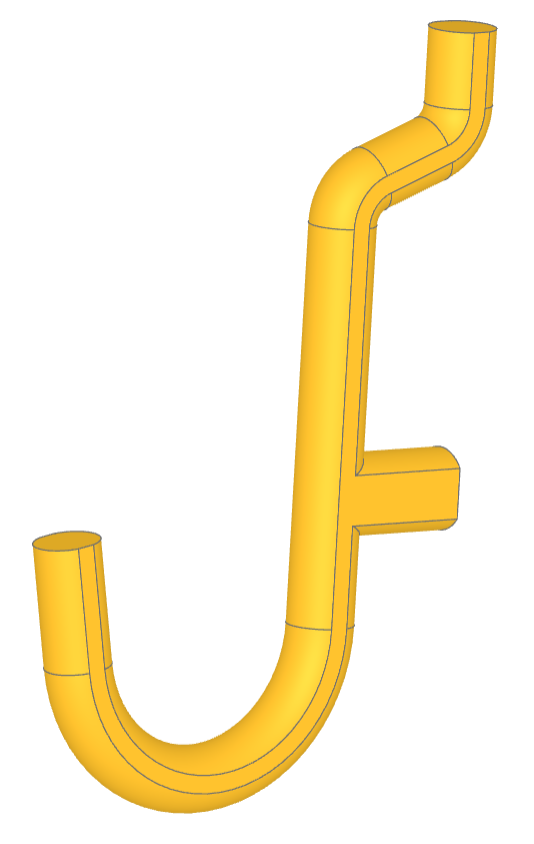
This script creates a a J-shaped pegboard hook. These hooks are commonly used for organizing tools in garages, workshops, or other spaces where tools and equipment need to be stored neatly and accessibly. The hook is created by defining a complex path and then sweeping it to define the hook. The sides of the hook are flattened to aid 3D printing.
🔨 Reference Implementation (Builder Mode)
from build123d import *
from ocp_vscode import show

pegd = 6.35 + 0.1  # mm ~0.25inch
c2c = 25.4  # mm 1.0inch
arcd = 7.2
both = 10
topx = 6
midx = 8
maind = 0.82 * pegd
midd = 1.0 * pegd
hookd = 23
hookx = 10
splitz = maind / 2 - 0.1
topangs = 70

with BuildPart() as mainp:
    with BuildLine(mode=Mode.PRIVATE) as sprof:
        l1 = Line((-both, 0), (c2c - arcd / 2 - 0.5, 0))
        l2 = JernArc(start=l1 @ 1, tangent=l1 % 1, radius=arcd / 2, arc_size=topangs)
        l3 = PolarLine(
            start=l2 @ 1,
            length=topx,
            direction=l2 % 1,
        )
        l4 = JernArc(start=l3 @ 1, tangent=l3 % 1, radius=arcd / 2, arc_size=-topangs)
        l5 = PolarLine(
            start=l4 @ 1,
            length=topx,
            direction=l4 % 1,
        )
        l6 = JernArc(
            start=l1 @ 0, tangent=(l1 % 0).reverse(), radius=hookd / 2, arc_size=170
        )
        l7 = PolarLine(
            start=l6 @ 1,
            length=hookx,
            direction=l6 % 1,
        )
    with BuildSketch(Plane.YZ):
        Circle(radius=maind / 2)
    sweep(path=sprof.wires()[0])
    with BuildLine(mode=Mode.PRIVATE) as stub:
        l7 = Line((0, 0), (0, midx + maind / 2))
    with BuildSketch(Plane.XZ):
        Circle(radius=midd / 2)
    sweep(path=stub.wires()[0])
    # splits help keep the object 3d printable by reducing overhang
    split(bisect_by=Plane(origin=(0, 0, -splitz)))
    split(bisect_by=Plane(origin=(0, 0, splitz)), keep=Keep.BOTTOM)

show(mainp)
✏️ Reference Implementation (Algebra Mode)
from build123d import *
from ocp_vscode import show

pegd = 6.35 + 0.1  # mm ~0.25inch
c2c = 25.4  # mm 1.0inch
arcd = 7.2
both = 10
topx = 6
midx = 8
maind = 0.82 * pegd
midd = 1.0 * pegd
hookd = 23
hookx = 10
splitz = maind / 2 - 0.1
topangs = 70

l1 = Line((-both, 0), (c2c - arcd / 2 - 0.5, 0))
l2 = JernArc(start=l1 @ 1, tangent=l1 % 1, radius=arcd / 2, arc_size=topangs)
l3 = PolarLine(
    start=l2 @ 1,
    length=topx,
    direction=l2 % 1,
)
l4 = JernArc(start=l3 @ 1, tangent=l3 % 1, radius=arcd / 2, arc_size=-topangs)
l5 = PolarLine(
    start=l4 @ 1,
    length=topx,
    direction=l4 % 1,
)
l6 = JernArc(start=l1 @ 0, tangent=(l1 % 0).reverse(), radius=hookd / 2, arc_size=170)
l7 = PolarLine(
    start=l6 @ 1,
    length=hookx,
    direction=l6 % 1,
)
sprof = Curve() + (l1, l2, l3, l4, l5, l6, l7)
wire = Wire(sprof.edges())  #  TODO sprof.wires() fails
mainp = sweep(Plane.YZ * Circle(radius=maind / 2), path=wire)

stub = Line((0, 0), (0, midx + maind / 2))
mainp += sweep(Plane.XZ * Circle(radius=midd / 2), path=stub)


# splits help keep the object 3d printable by reducing overhang
mainp = split(mainp, Plane(origin=(0, 0, -splitz)))
mainp = split(mainp, Plane(origin=(0, 0, splitz)), keep=Keep.BOTTOM)

show(mainp)
Platonic Solids
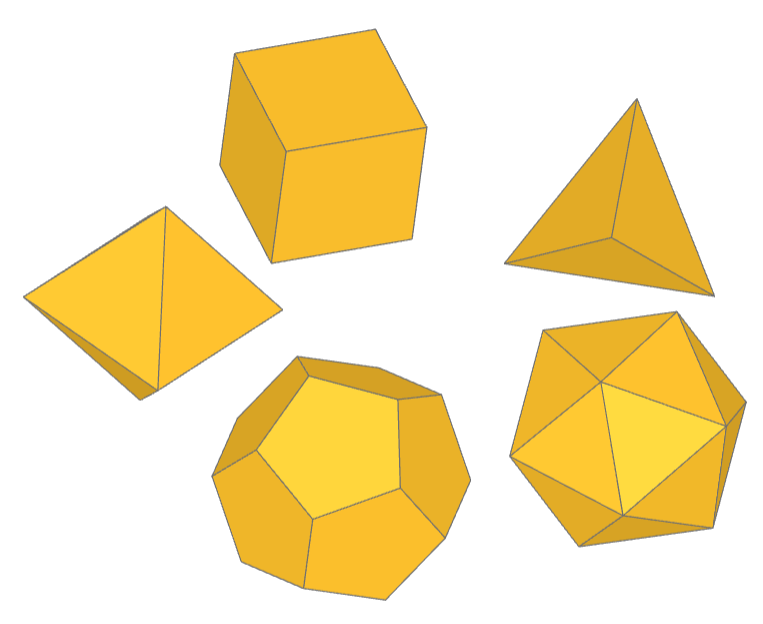
This example creates a custom Part object PlatonicSolid.
Platonic solids are five three-dimensional shapes that are highly symmetrical, known since antiquity and named after the ancient Greek philosopher Plato. These solids are unique because their faces are congruent regular polygons, with the same number of faces meeting at each vertex. The five Platonic solids are the tetrahedron (4 triangular faces), cube (6 square faces), octahedron (8 triangular faces), dodecahedron (12 pentagonal faces), and icosahedron (20 triangular faces). Each solid represents a unique way in which identical polygons can be arranged in three dimensions to form a convex polyhedron, embodying ideals of symmetry and balance.
✏️ Reference Implementation (Algebra Mode)
from build123d import *
from math import sqrt
from typing import Union, Literal
from scipy.spatial import ConvexHull

from ocp_vscode import show

PHI = (1 + sqrt(5)) / 2  # The Golden Ratio


class PlatonicSolid(BasePartObject):
    """Part Object: Platonic Solid

    Create one of the five convex Platonic solids.

    Args:
        face_count (Literal[4,6,8,12,20]): number of faces
        diameter (float): double distance to vertices, i.e. maximum size
        rotation (RotationLike, optional): angles to rotate about axes. Defaults to (0, 0, 0).
        align (Union[None, Align, tuple[Align, Align, Align]], optional): align min, center,
            or max of object. Defaults to None.
        mode (Mode, optional): combine mode. Defaults to Mode.ADD.
    """

    tetrahedron_vertices = [(1, 1, 1), (1, -1, -1), (-1, 1, -1), (-1, -1, 1)]

    cube_vertices = [(i, j, k) for i in [-1, 1] for j in [-1, 1] for k in [-1, 1]]

    octahedron_vertices = (
        [(i, 0, 0) for i in [-1, 1]]
        + [(0, i, 0) for i in [-1, 1]]
        + [(0, 0, i) for i in [-1, 1]]
    )

    dodecahedron_vertices = (
        [(i, j, k) for i in [-1, 1] for j in [-1, 1] for k in [-1, 1]]
        + [(0, i / PHI, j * PHI) for i in [-1, 1] for j in [-1, 1]]
        + [(i / PHI, j * PHI, 0) for i in [-1, 1] for j in [-1, 1]]
        + [(i * PHI, 0, j / PHI) for i in [-1, 1] for j in [-1, 1]]
    )

    icosahedron_vertices = (
        [(0, i, j * PHI) for i in [-1, 1] for j in [-1, 1]]
        + [(i, j * PHI, 0) for i in [-1, 1] for j in [-1, 1]]
        + [(i * PHI, 0, j) for i in [-1, 1] for j in [-1, 1]]
    )

    vertices_lookup = {
        4: tetrahedron_vertices,
        6: cube_vertices,
        8: octahedron_vertices,
        12: dodecahedron_vertices,
        20: icosahedron_vertices,
    }
    _applies_to = [BuildPart._tag]

    def __init__(
        self,
        face_count: Literal[4, 6, 8, 12, 20],
        diameter: float = 1.0,
        rotation: RotationLike = (0, 0, 0),
        align: Union[None, Align, tuple[Align, Align, Align]] = None,
        mode: Mode = Mode.ADD,
    ):
        try:
            platonic_vertices = PlatonicSolid.vertices_lookup[face_count]
        except KeyError:
            raise ValueError(
                f"face_count must be one of 4, 6, 8, 12, or 20 not {face_count}"
            )

        # Create a convex hull from the vertices
        hull = ConvexHull(platonic_vertices).simplices.tolist()

        # Create faces from the vertex indices
        platonic_faces = []
        for face_vertex_indices in hull:
            corner_vertices = [platonic_vertices[i] for i in face_vertex_indices]
            platonic_faces.append(Face(Wire.make_polygon(corner_vertices)))

        # Create the solid from the Faces
        platonic_solid = Solid(Shell(platonic_faces)).clean()

        # By definition, all vertices are the same distance from the origin so
        # scale proportionally to this distance
        platonic_solid = platonic_solid.scale(
            (diameter / 2) / Vector(platonic_solid.vertices()[0]).length
        )

        super().__init__(part=platonic_solid, rotation=rotation, align=align, mode=mode)


solids = [
    Rot(0, 0, 72 * i) * Pos(1, 0, 0) * PlatonicSolid(faces)
    for i, faces in enumerate([4, 6, 8, 12, 20])
]
show(solids)
Playing Cards
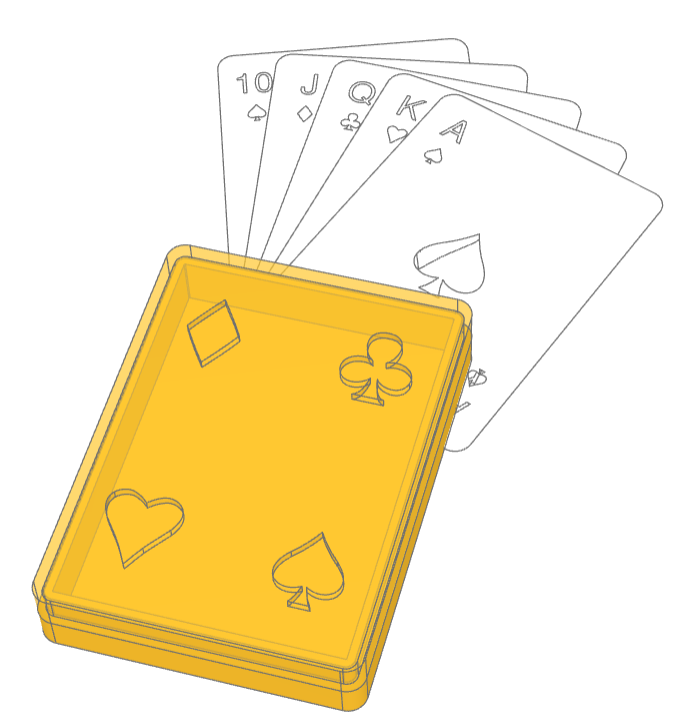
This example creates a customs Sketch objects: Club, Spade, Heart, Diamond, and PlayingCard in addition to a two part playing card box which has suit cutouts in the lid. The four suits are created with Bézier curves that were imported as code from an SVG file and modified to the code found here.
🔨 Reference Implementation (Builder Mode)
from typing import Literal
from build123d import *
from ocp_vscode import show_object


# [Club]
class Club(BaseSketchObject):
    def __init__(
        self,
        height: float,
        rotation: float = 0,
        align: tuple[Align, Align] = (Align.CENTER, Align.CENTER),
        mode: Mode = Mode.ADD,
    ):
        with BuildSketch() as club:
            with BuildLine():
                l0 = Line((0, -188), (76, -188))
                b0 = Bezier(l0 @ 1, (61, -185), (33, -173), (17, -81))
                b1 = Bezier(b0 @ 1, (49, -128), (146, -145), (167, -67))
                b2 = Bezier(b1 @ 1, (187, 9), (94, 52), (32, 18))
                b3 = Bezier(b2 @ 1, (92, 57), (113, 188), (0, 188))
                mirror(about=Plane.YZ)
            make_face()
            scale(by=height / club.sketch.bounding_box().size.Y)
        super().__init__(obj=club.sketch, rotation=rotation, align=align, mode=mode)


# [Club]


class Spade(BaseSketchObject):
    def __init__(
        self,
        height: float,
        rotation: float = 0,
        align: tuple[Align, Align] = (Align.CENTER, Align.CENTER),
        mode: Mode = Mode.ADD,
    ):
        with BuildSketch() as spade:
            with BuildLine():
                b0 = Bezier((0, 198), (6, 190), (41, 127), (112, 61))
                b1 = Bezier(b0 @ 1, (242, -72), (114, -168), (11, -105))
                b2 = Bezier(b1 @ 1, (31, -174), (42, -179), (53, -198))
                l0 = Line(b2 @ 1, (0, -198))
                mirror(about=Plane.YZ)
            make_face()
            scale(by=height / spade.sketch.bounding_box().size.Y)
        super().__init__(obj=spade.sketch, rotation=rotation, align=align, mode=mode)


class Heart(BaseSketchObject):
    def __init__(
        self,
        height: float,
        rotation: float = 0,
        align: tuple[Align, Align] = (Align.CENTER, Align.CENTER),
        mode: Mode = Mode.ADD,
    ):
        with BuildSketch() as heart:
            with BuildLine():
                b1 = Bezier((0, 146), (20, 169), (67, 198), (97, 198))
                b2 = Bezier(b1 @ 1, (125, 198), (151, 186), (168, 167))
                b3 = Bezier(b2 @ 1, (197, 133), (194, 88), (158, 31))
                b4 = Bezier(b3 @ 1, (126, -13), (94, -48), (62, -95))
                b5 = Bezier(b4 @ 1, (40, -128), (0, -198))
                mirror(about=Plane.YZ)
            make_face()
            scale(by=height / heart.sketch.bounding_box().size.Y)
        super().__init__(obj=heart.sketch, rotation=rotation, align=align, mode=mode)


class Diamond(BaseSketchObject):
    def __init__(
        self,
        height: float,
        rotation: float = 0,
        align: tuple[Align, Align] = (Align.CENTER, Align.CENTER),
        mode: Mode = Mode.ADD,
    ):
        with BuildSketch() as diamond:
            with BuildLine():
                Bezier((135, 0), (94, 69), (47, 134), (0, 198))
                mirror(about=Plane.XZ)
                mirror(about=Plane.YZ)
            make_face()
            scale(by=height / diamond.sketch.bounding_box().size.Y)
        super().__init__(obj=diamond.sketch, rotation=rotation, align=align, mode=mode)


card_width = 2.5 * IN
card_length = 3.5 * IN
deck = 0.5 * IN
wall = 4 * MM
gap = 0.5 * MM

with BuildPart() as box_builder:
    with BuildSketch() as plan:
        Rectangle(card_width + 2 * wall, card_length + 2 * wall)
        fillet(plan.vertices(), radius=card_width / 15)
    extrude(amount=wall / 2)
    with BuildSketch(box_builder.faces().sort_by(Axis.Z)[-1]) as walls:
        add(plan.sketch)
        offset(plan.sketch, amount=-wall, mode=Mode.SUBTRACT)
    extrude(amount=deck / 2)
    with BuildSketch(box_builder.faces().sort_by(Axis.Z)[-1]) as inset_walls:
        offset(plan.sketch, amount=-(wall + gap) / 2, mode=Mode.ADD)
        offset(plan.sketch, amount=-wall, mode=Mode.SUBTRACT)
    extrude(amount=deck / 2)

with BuildPart() as lid_builder:
    with BuildSketch() as outset_walls:
        add(plan.sketch)
        offset(plan.sketch, amount=-(wall - gap) / 2, mode=Mode.SUBTRACT)
    extrude(amount=deck / 2)
    with BuildSketch(lid_builder.faces().sort_by(Axis.Z)[-1]) as top:
        add(plan.sketch)
    extrude(amount=wall / 2)
    with BuildSketch(lid_builder.faces().sort_by(Axis.Z)[-1]):
        holes = GridLocations(
            3 * card_width / 5, 3 * card_length / 5, 2, 2
        ).local_locations
        for i, hole in enumerate(holes):
            with Locations(hole) as hole_loc:
                if i == 0:
                    Heart(card_length / 5)
                elif i == 1:
                    Diamond(card_length / 5)
                elif i == 2:
                    Spade(card_length / 5)
                elif i == 3:
                    Club(card_length / 5)
    extrude(amount=-wall, mode=Mode.SUBTRACT)

box = Compound(
    [box_builder.part, lid_builder.part.moved(Location((0, 0, (wall + deck) / 2)))]
)
visible, hidden = box.project_to_viewport((70, -50, 120))
max_dimension = max(*Compound(children=visible + hidden).bounding_box().size)
exporter = ExportSVG(scale=100 / max_dimension)
exporter.add_layer("Visible")
exporter.add_layer("Hidden", line_color=(99, 99, 99), line_type=LineType.ISO_DOT)
exporter.add_shape(visible, layer="Visible")
exporter.add_shape(hidden, layer="Hidden")
# exporter.write(f"assets/card_box.svg")


class PlayingCard(BaseSketchObject):
    """PlayingCard

    A standard playing card modelled as a Face.

    Args:
        rank (Literal['A', '2' .. '10', 'J', 'Q', 'K']): card rank
        suit (Literal['Clubs', 'Spades', 'Hearts', 'Diamonds']): card suit
    """

    width = 2.5 * IN
    height = 3.5 * IN
    suits = {"Clubs": Club, "Spades": Spade, "Hearts": Heart, "Diamonds": Diamond}
    ranks = ["A", "2", "3", "4", "5", "6", "7", "8", "9", "10", "J", "Q", "K"]

    def __init__(
        self,
        rank: Literal["A", "2", "3", "4", "5", "6", "7", "8", "9", "10", "J", "Q", "K"],
        suit: Literal["Clubs", "Spades", "Hearts", "Diamonds"],
        rotation: float = 0,
        align: tuple[Align, Align] = (Align.CENTER, Align.CENTER),
        mode: Mode = Mode.ADD,
    ):
        with BuildSketch() as playing_card:
            Rectangle(
                PlayingCard.width, PlayingCard.height, align=(Align.MIN, Align.MIN)
            )
            fillet(playing_card.vertices(), radius=PlayingCard.width / 15)
            with Locations(
                (
                    PlayingCard.width / 7,
                    8 * PlayingCard.height / 9,
                )
            ):
                Text(
                    txt=rank,
                    font_size=PlayingCard.width / 7,
                    mode=Mode.SUBTRACT,
                )
            with Locations(
                (
                    PlayingCard.width / 7,
                    7 * PlayingCard.height / 9,
                )
            ):
                PlayingCard.suits[suit](
                    height=PlayingCard.width / 12, mode=Mode.SUBTRACT
                )
            with Locations(
                (
                    6 * PlayingCard.width / 7,
                    1 * PlayingCard.height / 9,
                )
            ):
                Text(
                    txt=rank,
                    font_size=PlayingCard.width / 7,
                    rotation=180,
                    mode=Mode.SUBTRACT,
                )
            with Locations(
                (
                    6 * PlayingCard.width / 7,
                    2 * PlayingCard.height / 9,
                )
            ):
                PlayingCard.suits[suit](
                    height=PlayingCard.width / 12, rotation=180, mode=Mode.SUBTRACT
                )
            rank_int = PlayingCard.ranks.index(rank) + 1
            rank_int = rank_int if rank_int < 10 else 1
            with Locations((PlayingCard.width / 2, PlayingCard.height / 2)):
                center_radius = 0 if rank_int == 1 else PlayingCard.width / 3.5
                suit_rotation = 0 if rank_int == 1 else -90
                suit_height = (
                    0.00159 * rank_int**2 - 0.0380 * rank_int + 0.37
                ) * PlayingCard.width
                with PolarLocations(
                    radius=center_radius,
                    count=rank_int,
                    start_angle=90 if rank_int > 1 else 0,
                ):
                    PlayingCard.suits[suit](
                        height=suit_height,
                        rotation=suit_rotation,
                        mode=Mode.SUBTRACT,
                    )
        super().__init__(
            obj=playing_card.sketch, rotation=rotation, align=align, mode=mode
        )


ace_spades = PlayingCard(rank="A", suit="Spades", align=Align.MIN)
ace_spades.color = Color("white")
king_hearts = PlayingCard(rank="K", suit="Hearts", align=Align.MIN)
king_hearts.color = Color("white")
queen_clubs = PlayingCard(rank="Q", suit="Clubs", align=Align.MIN)
queen_clubs.color = Color("white")
jack_diamonds = PlayingCard(rank="J", suit="Diamonds", align=Align.MIN)
jack_diamonds.color = Color("white")
ten_spades = PlayingCard(rank="10", suit="Spades", align=Align.MIN)
ten_spades.color = Color("white")

hand = Compound(
    children=[
        Rot(0, 0, -20) * Pos(0, 0, 0) * ace_spades,
        Rot(0, 0, -10) * Pos(0, 0, -1) * king_hearts,
        Rot(0, 0, 0) * Pos(0, 0, -2) * queen_clubs,
        Rot(0, 0, 10) * Pos(0, 0, -3) * jack_diamonds,
        Rot(0, 0, 20) * Pos(0, 0, -4) * ten_spades,
    ]
)

show_object(Pos(-20, 40) * hand)
show_object(box_builder.part, "box_builder")
show_object(
    Pos(0, 0, (wall + deck) / 2) * lid_builder.part,
    "lid_builder",
    options={"alpha": 0.7},
)
Stud Wall
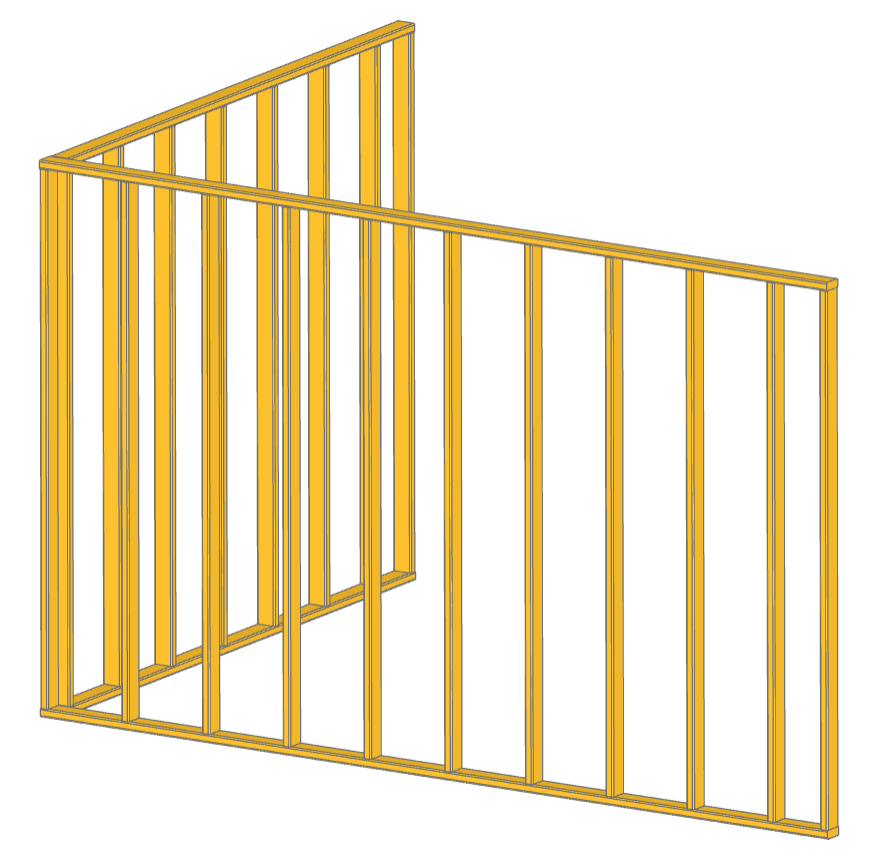
This example demonstrates creating custom Part objects and putting them into assemblies. The custom object is a Stud used in the building industry while the assembly is a StudWall created from copies of Stud objects for efficiency. Both the Stud and StudWall objects use RigidJoints to define snap points which are used to position all of objects.
✏️ Reference Implementation (Algebra Mode)
class Stud(BasePartObject):
    """Part Object: Stud

    Create a dimensional framing stud.

    Args:
        length (float): stud size
        width (float): stud size
        thickness (float): stud size
        rotation (RotationLike, optional): angles to rotate about axes. Defaults to (0, 0, 0).
        align (Union[Align, tuple[Align, Align, Align]], optional): align min, center,
            or max of object. Defaults to (Align.CENTER, Align.CENTER, Align.MIN).
        mode (Mode, optional): combine mode. Defaults to Mode.ADD.
    """

    _applies_to = [BuildPart._tag]

    def __init__(
        self,
        length: float = 8 * FT,
        width: float = 3.5 * IN,
        thickness: float = 1.5 * IN,
        rotation: RotationLike = (0, 0, 0),
        align: Union[None, Align, tuple[Align, Align, Align]] = (
            Align.CENTER,
            Align.CENTER,
            Align.MIN,
        ),
        mode: Mode = Mode.ADD,
    ):
        self.length = length
        self.width = width
        self.thickness = thickness

        # Create the basic shape
        with BuildPart() as stud:
            with BuildSketch():
                RectangleRounded(thickness, width, 0.25 * IN)
            extrude(amount=length)

        # Create a Part object with appropriate alignment and rotation
        super().__init__(part=stud.part, rotation=rotation, align=align, mode=mode)

        # Add joints to the ends of the stud
        RigidJoint("end0", self, Location())
        RigidJoint("end1", self, Location((0, 0, length), (1, 0, 0), 180))


class StudWall(Compound):
    """StudWall

    A simple stud wall assembly with top and sole plates.

    Args:
        length (float): wall length
        depth (float, optional): stud width. Defaults to 3.5*IN.
        height (float, optional): wall height. Defaults to 8*FT.
        stud_spacing (float, optional): center-to-center. Defaults to 16*IN.
        stud_thickness (float, optional): Defaults to 1.5*IN.
    """

    def __init__(
        self,
        length: float,
        depth: float = 3.5 * IN,
        height: float = 8 * FT,
        stud_spacing: float = 16 * IN,
        stud_thickness: float = 1.5 * IN,
    ):
        # Create the object that will be used for top and sole plates
        plate = Stud(
            length,
            depth,
            rotation=(0, -90, 0),
            align=(Align.MIN, Align.CENTER, Align.MAX),
        )
        # Define where studs will go on the plates
        stud_locations = Pos(stud_thickness / 2, 0, stud_thickness) * GridLocations(
            stud_spacing, 0, int(length / stud_spacing) + 1, 1, align=Align.MIN
        )
        stud_locations.append(Pos(length - stud_thickness / 2, 0, stud_thickness))

        # Create a single stud that will be copied for efficiency
        stud = Stud(height - 2 * stud_thickness, depth, stud_thickness)

        # For efficiency studs in the walls are copies with their own position
        studs = []
        for i, loc in enumerate(stud_locations):
            stud_joint = RigidJoint(f"stud{i}", plate, loc)
            stud_copy = copy.copy(stud)
            stud_joint.connect_to(stud_copy.joints["end0"])
            studs.append(stud_copy)
        top_plate = copy.copy(plate)
        sole_plate = copy.copy(plate)

        # Position the top plate relative to the top of the first stud
        studs[0].joints["end1"].connect_to(top_plate.joints["stud0"])

        # Build the assembly of parts
        super().__init__(children=[top_plate, sole_plate] + studs)

        # Add joints to the wall
        RigidJoint("inside0", self, Location((depth / 2, depth / 2, 0), (0, 0, 1), 90))
        RigidJoint("end0", self, Location())


x_wall = StudWall(13 * FT)
y_wall = StudWall(9 * FT)
x_wall.joints["inside0"].connect_to(y_wall.joints["end0"])

show(x_wall, y_wall, render_joints=False)
Tea Cup
🔨 Reference Implementation (Builder Mode)
from build123d import *
from ocp_vscode import show

wall_thickness = 3 * MM
fillet_radius = wall_thickness * 0.49

with BuildPart() as tea_cup:
    # Create the bowl of the cup as a revolved cross section
    with BuildSketch(Plane.XZ) as bowl_section:
        with BuildLine():
            # Start & end points with control tangents
            s = Spline(
                (30 * MM, 10 * MM),
                (69 * MM, 105 * MM),
                tangents=((1, 0.5), (0.7, 1)),
                tangent_scalars=(1.75, 1),
            )
            # Lines to finish creating ½ the bowl shape
            Polyline(s @ 0, s @ 0 + (10 * MM, -10 * MM), (0, 0), (0, (s @ 1).Y), s @ 1)
        make_face()  # Create a filled 2D shape
    revolve(axis=Axis.Z)
    # Hollow out the bowl with openings on the top and bottom
    offset(amount=-wall_thickness, openings=tea_cup.faces().filter_by(GeomType.PLANE))
    # Add a bottom to the bowl
    with Locations((0, 0, (s @ 0).Y)):
        Cylinder(radius=(s @ 0).X, height=wall_thickness)
    # Smooth out all the edges
    fillet(tea_cup.edges(), radius=fillet_radius)

    # Determine where the handle contacts the bowl
    handle_intersections = [
        tea_cup.part.find_intersection_points(
            Axis(origin=(0, 0, vertical_offset), direction=(1, 0, 0))
        )[-1][0]
        for vertical_offset in [35 * MM, 80 * MM]
    ]
    # Create a path for handle creation
    with BuildLine(Plane.XZ) as handle_path:
        Spline(
            handle_intersections[0] - (wall_thickness / 2, 0),
            handle_intersections[0] + (35 * MM, 30 * MM),
            handle_intersections[0] + (40 * MM, 60 * MM),
            handle_intersections[1] - (wall_thickness / 2, 0),
            tangents=((1, 1.25), (-0.2, -1)),
        )
    # Align the cross section to the beginning of the path
    with BuildSketch(handle_path.line ^ 0) as handle_cross_section:
        RectangleRounded(wall_thickness, 8 * MM, fillet_radius)
    sweep()  # Sweep handle cross section along path

assert abs(tea_cup.part.volume - 130326) < 1

show(tea_cup, names=["tea cup"])
✏️ Reference Implementation (Algebra Mode)
from build123d import *
from ocp_vscode import show

wall_thickness = 3 * MM
fillet_radius = wall_thickness * 0.49

# Create the bowl of the cup as a revolved cross section

# Start & end points with control tangents
s = Spline(
    (30 * MM, 10 * MM),
    (69 * MM, 105 * MM),
    tangents=((1, 0.5), (0.7, 1)),
    tangent_scalars=(1.75, 1),
)
# Lines to finish creating ½ the bowl shape
s += Polyline(s @ 0, s @ 0 + (10 * MM, -10 * MM), (0, 0), (0, (s @ 1).Y), s @ 1)
bowl_section = Plane.XZ * make_face(s)  # Create a filled 2D shape
tea_cup = revolve(bowl_section, axis=Axis.Z)

# Hollow out the bowl with openings on the top and bottom
tea_cup = offset(
    tea_cup, -wall_thickness, openings=tea_cup.faces().filter_by(GeomType.PLANE)
)

# Add a bottom to the bowl
tea_cup += Pos(0, 0, (s @ 0).Y) * Cylinder(radius=(s @ 0).X, height=wall_thickness)

# Smooth out all the edges
tea_cup = fillet(tea_cup.edges(), radius=fillet_radius)

# Determine where the handle contacts the bowl
handle_intersections = [
    tea_cup.find_intersection_points(
        Axis(origin=(0, 0, vertical_offset), direction=(1, 0, 0))
    )[-1][0]
    for vertical_offset in [35 * MM, 80 * MM]
]

# Create a path for handle creation
path_spline = Spline(
    handle_intersections[0] - (wall_thickness / 2, 0, 0),
    handle_intersections[0] + (35 * MM, 0, 30 * MM),
    handle_intersections[0] + (40 * MM, 0, 60 * MM),
    handle_intersections[1] - (wall_thickness / 2, 0, 0),
    tangents=((1, 0, 1.25), (-0.2, 0, -1)),
)

# Align the cross section to the beginning of the path
location = path_spline ^ 0
handle_cross_section = location * RectangleRounded(wall_thickness, 8 * MM, fillet_radius)

# Sweep handle cross section along path
tea_cup += sweep(handle_cross_section, path=path_spline)

# assert abs(tea_cup.part.volume - 130326.77052487945) < 1e-3

show(tea_cup, names=["tea cup"])
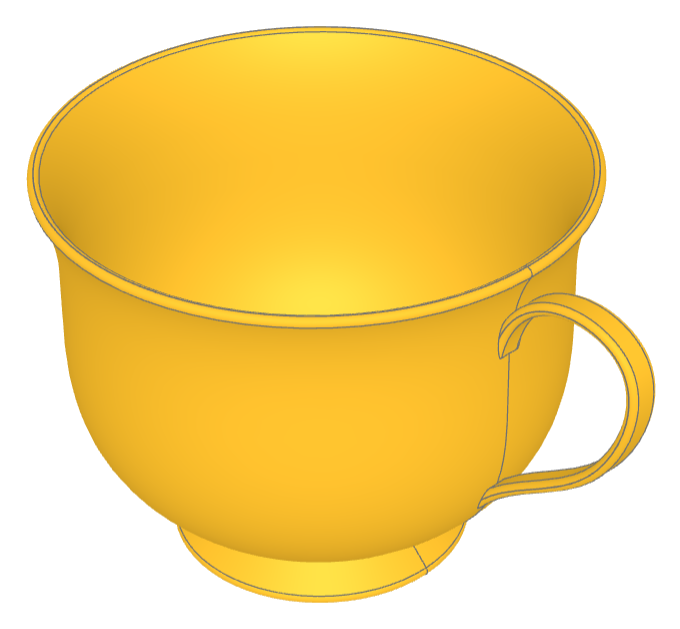
This example demonstrates the creation a tea cup, which serves as an example of constructing complex, non-flat geometrical shapes programmatically.
The tea cup model involves several CAD techniques, such as:
Revolve Operations: There is 1 occurrence of a revolve operation. This is used to create the main body of the tea cup by revolving a profile around an axis, a common technique for generating symmetrical objects like cups.
Sweep Operations: There are 2 occurrences of sweep operations. The handle are created by sweeping a profile along a path to generate non-planar surfaces.
Offset/Shell Operations: the bowl of the cup is hollowed out with the offset operation leaving the top open.
Fillet Operations: There is 1 occurrence of a fillet operation which is used to round the edges for aesthetic improvement and to mimic real-world objects more closely.
Toy Truck
🔨 Reference Implementation (Builder Mode)
from build123d import *
from ocp_vscode import show

# Toy Truck Blue
truck_color = Color(0x4683CE)

# Create the main truck body — from bumper to bed, excluding the cab
with BuildPart() as body:
    # The body has two axes of symmetry, so we start with a centered sketch.
    # The default workplane is Plane.XY.
    with BuildSketch() as body_skt:
        Rectangle(20, 35)
        # Fillet all the corners of the sketch.
        # Alternatively, you could use RectangleRounded.
        fillet(body_skt.vertices(), 1)

    # Extrude the body shape upward
    extrude(amount=10, taper=4)
    # Reuse the sketch by accessing it explicitly
    extrude(body_skt.sketch, amount=8, taper=2)

    # Create symmetric fenders on Plane.YZ
    with BuildSketch(Plane.YZ) as fender:
        # The trapezoid has asymmetric angles (80°, 88°)
        Trapezoid(18, 6, 80, 88, align=Align.MIN)
        # Fillet top edge vertices (Y-direction highest group)
        fillet(fender.vertices().group_by(Axis.Y)[-1], 1.5)

    # Extrude the fender in both directions
    extrude(amount=10.5, both=True)

    # Create wheel wells with a shifted sketch on Plane.YZ
    with BuildSketch(Plane.YZ.shift_origin((0, 3.5, 0))) as wheel_well:
        Trapezoid(12, 4, 70, 85, align=Align.MIN)
        fillet(wheel_well.vertices().group_by(Axis.Y)[-1], 2)

    # Subtract the wheel well geometry
    extrude(amount=10.5, both=True, mode=Mode.SUBTRACT)

    # Fillet the top edges of the body
    fillet(body.edges().group_by(Axis.Z)[-1], 1)

    # Isolate a set of body edges and preview before filleting
    body_edges = body.edges().group_by(Axis.Z)[-6]
    fillet(body_edges, 0.1)

    # Combine edge groups from both sides of the fender and fillet them
    fender_edges = body.edges().group_by(Axis.X)[0] + body.edges().group_by(Axis.X)[-1]
    fender_edges = fender_edges.group_by(Axis.Z)[1:]
    fillet(fender_edges, 0.4)

    # Create a sketch on the front of the truck for the grill
    with BuildSketch(
        Plane.XZ.offset(-body.vertices().sort_by(Axis.Y)[-1].Y - 0.5)
    ) as grill:
        Rectangle(16, 8.5, align=(Align.CENTER, Align.MIN))
        fillet(grill.vertices().group_by(Axis.Y)[-1], 1)

        # Add headlights (subtractive circles)
        with Locations((0, 6.5)):
            with GridLocations(12, 0, 2, 1):
                Circle(1, mode=Mode.SUBTRACT)

        # Add air vents (subtractive slots)
        with Locations((0, 3)):
            with GridLocations(0, 0.8, 1, 4):
                SlotOverall(10, 0.5, mode=Mode.SUBTRACT)

    # Extrude the grill forward
    extrude(amount=2)

    # Fillet only the outer grill edges (exclude headlight/vent cuts)
    grill_perimeter = body.faces().sort_by(Axis.Y)[-1].outer_wire()
    fillet(grill_perimeter.edges(), 0.2)

    # Create the bumper as a separate part inside the body
    with BuildPart() as bumper:
        # Find the midpoint of a front edge and shift slightly to position the bumper
        front_cnt = body.edges().group_by(Axis.Z)[0].sort_by(Axis.Y)[-1] @ 0.5 - (0, 3)

        with BuildSketch() as bumper_plan:
            # Use BuildLine to draw an elliptical arc and offset
            with BuildLine():
                EllipticalCenterArc(front_cnt, 20, 4, start_angle=60, arc_size=60)
                offset(amount=1)
            make_face()

        # Extrude the bumper symmetrically
        extrude(amount=1, both=True)
        fillet(bumper.edges(), 0.25)

    # Define a joint on top of the body to connect the cab later
    RigidJoint("body_top", joint_location=Location((0, -7.5, 10)))
    body.part.color = truck_color

# Create the cab as an independent part to mount on the body
with BuildPart() as cab:
    with BuildSketch() as cab_plan:
        RectangleRounded(16, 16, 1)
        # Split the sketch to work on one symmetric half
        split(bisect_by=Plane.YZ)

    # Extrude the cab forward and upward at an angle
    extrude(amount=7, dir=(0, 0.15, 1))
    fillet(cab.edges().group_by(Axis.Z)[-1].group_by(Axis.X)[1:], 1)

    # Rear window
    with BuildSketch(Plane.XZ.shift_origin((0, 0, 3))) as rear_window:
        RectangleRounded(8, 4, 0.75)
    extrude(amount=10, mode=Mode.SUBTRACT)

    # Front window
    with BuildSketch(Plane.XZ) as front_window:
        RectangleRounded(15.2, 11, 0.75)
    extrude(amount=-10, mode=Mode.SUBTRACT)

    # Side windows
    with BuildSketch(Plane.YZ) as side_window:
        with Locations((3.5, 0)):
            with GridLocations(10, 0, 2, 1):
                Trapezoid(9, 5.5, 80, 100, align=(Align.CENTER, Align.MIN))
                fillet(side_window.vertices().group_by(Axis.Y)[-1], 0.5)
    extrude(amount=12, both=True, mode=Mode.SUBTRACT)

    # Mirror to complete the cab
    mirror(about=Plane.YZ)

    # Define joint on cab base
    RigidJoint("cab_base", joint_location=Location((0, 0, 0)))
    cab.part.color = truck_color

# Attach the cab to the truck body using joints
body.joints["body_top"].connect_to(cab.joints["cab_base"])

# Show the result
show(body.part, cab.part)
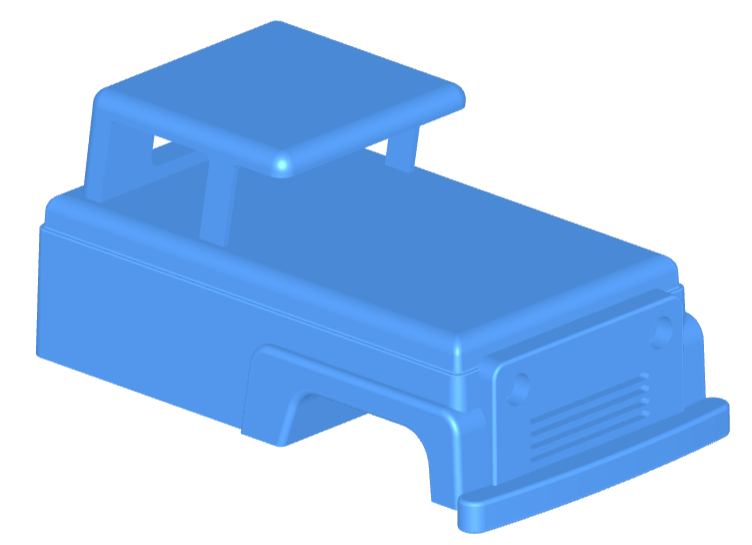
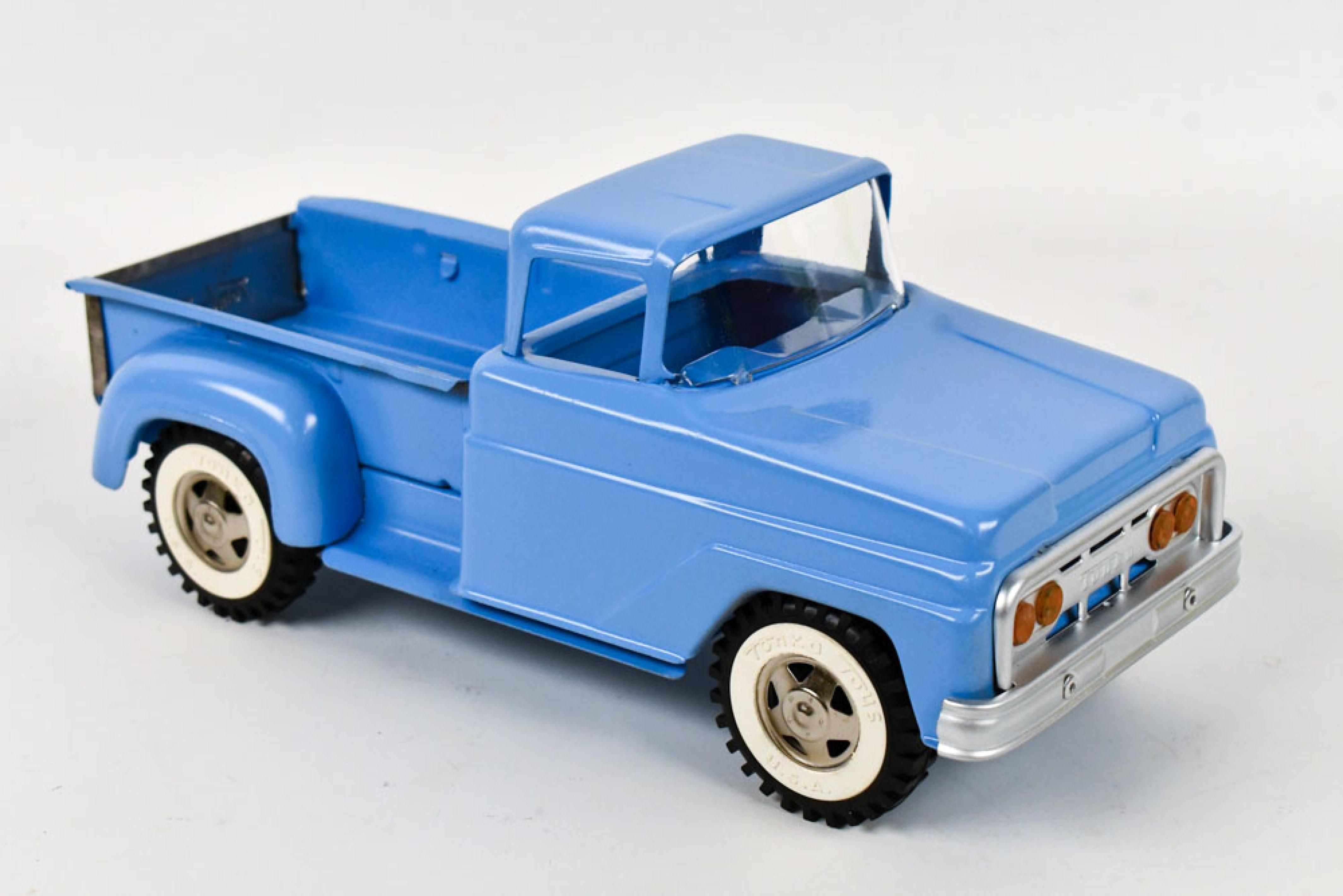
This example demonstrates how to design a toy truck using BuildPart and BuildSketch in Builder mode. The model includes a detailed body, cab, grill, and bumper, showcasing techniques like sketch reuse, symmetry, tapered extrusions, selective filleting, and the use of joints for part assembly. Ideal for learning complex part construction and hierarchical modeling in build123d.
Vase
🔨 Reference Implementation (Builder Mode)
from build123d import *
from ocp_vscode import show_object

with BuildPart() as vase:
    with BuildSketch() as profile:
        with BuildLine() as outline:
            l1 = Line((0, 0), (12, 0))
            l2 = RadiusArc(l1 @ 1, (15, 20), 50)
            l3 = Spline(l2 @ 1, (22, 40), (20, 50), tangents=(l2 % 1, (-0.75, 1)))
            l4 = RadiusArc(l3 @ 1, l3 @ 1 + Vector(0, 5), 5)
            l5 = Spline(
                l4 @ 1,
                l4 @ 1 + Vector(2.5, 2.5),
                l4 @ 1 + Vector(0, 5),
                tangents=(l4 % 1, (-1, 0)),
            )
            Polyline(
                l5 @ 1,
                l5 @ 1 + Vector(0, 1),
                (0, (l5 @ 1).Y + 1),
                l1 @ 0,
            )
        make_face()
    revolve(axis=Axis.Y)
    offset(openings=vase.faces().filter_by(Axis.Y)[-1], amount=-1)
    top_edges = (
        vase.edges().filter_by_position(Axis.Y, 60, 62).filter_by(GeomType.CIRCLE)
    )
    fillet(top_edges, radius=0.25)
    fillet(vase.edges().sort_by(Axis.Y)[0], radius=0.5)


show_object(Rot(90, 0, 0) * vase.part, name="vase")
✏️ Reference Implementation (Algebra Mode)
from build123d import *
from ocp_vscode import show_object

l1 = Line((0, 0), (12, 0))
l2 = RadiusArc(l1 @ 1, (15, 20), 50)
l3 = Spline(l2 @ 1, (22, 40), (20, 50), tangents=(l2 % 1, (-0.75, 1)))
l4 = RadiusArc(l3 @ 1, l3 @ 1 + Vector(0, 5), 5)
l5 = Spline(
    l4 @ 1,
    l4 @ 1 + Vector(2.5, 2.5),
    l4 @ 1 + Vector(0, 5),
    tangents=(l4 % 1, (-1, 0)),
)
outline = l1 + l2 + l3 + l4 + l5
outline += Polyline(
    l5 @ 1,
    l5 @ 1 + Vector(0, 1),
    (0, (l5 @ 1).Y + 1),
    l1 @ 0,
)
profile = make_face(outline.edges())
vase = revolve(profile, Axis.Y)
vase = offset(vase, openings=vase.faces().sort_by(Axis.Y).last, amount=-1)

top_edges = vase.edges().filter_by(GeomType.CIRCLE).filter_by_position(Axis.Y, 60, 62)
vase = fillet(top_edges, radius=0.25)

vase = fillet(vase.edges().sort_by(Axis.Y).first, radius=0.5)

show_object(Rot(90, 0, 0) * vase, name="vase")
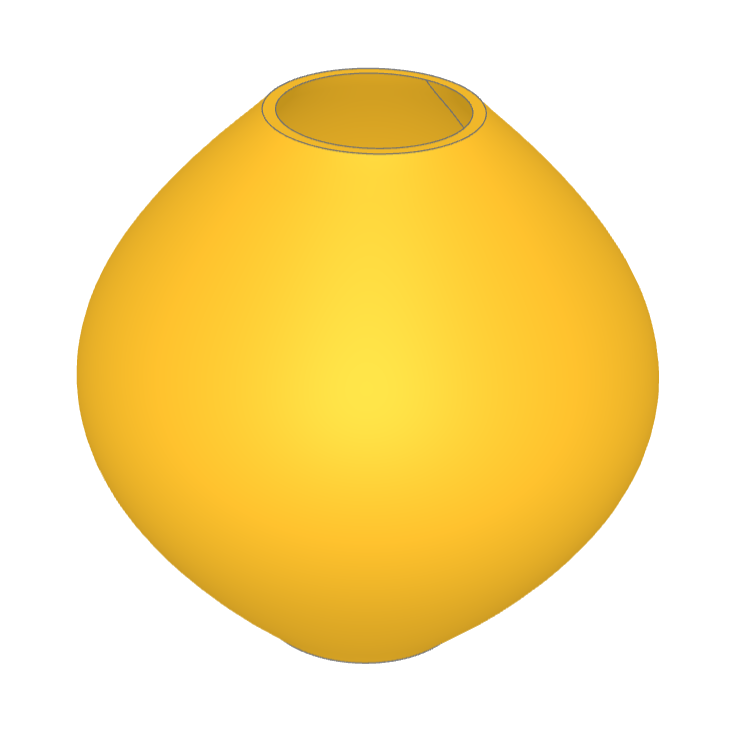
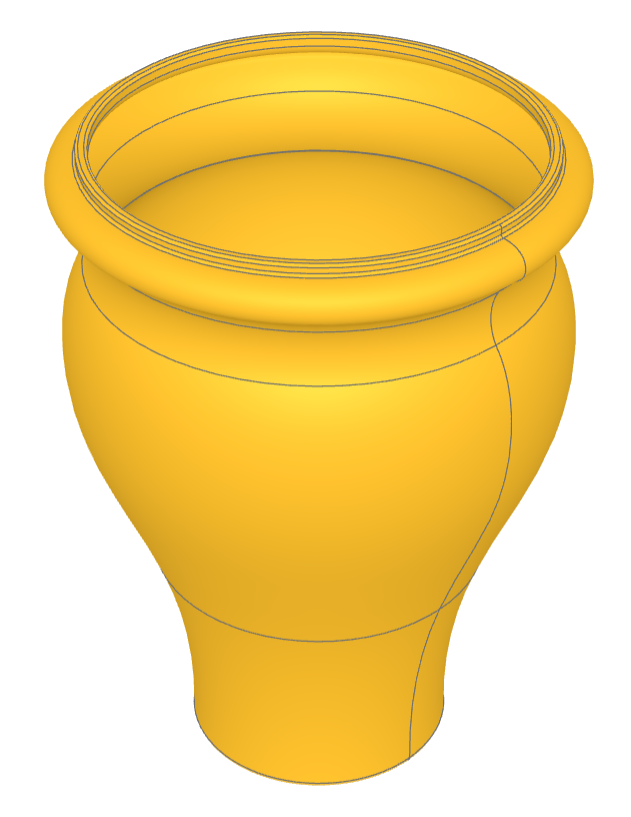
This example demonstrates the build123d techniques involving the creation of a vase. Specifically, it showcases the processes of revolving a sketch, shelling (creating a hollow object by removing material from its interior), and selecting edges by position range and type for the application of fillets (rounding off the edges).
Sketching: Drawing a 2D profile or outline that represents the side view of the vase.
Revolving: Rotating the sketch around an axis to create a 3D object. This step transforms the 2D profile into a 3D vase shape.
Offset/Shelling: Removing material from the interior of the solid vase to create a hollow space, making it resemble a real vase more closely.
Edge Filleting: Selecting specific edges of the vase for filleting, which involves rounding those edges. The edges are selected based on their position and type.